
Warcraft: The Structure Beneath the Lore
A whole-world reading of how power becomes history—and history becomes inheritance—on the road to Icecrown.
Introduction: The Office Left Behind
At the summit of Icecrown Citadel, the heroes of Azeroth find the ending they came for. Arthas Menethil lies dead beside the Frozen Throne. Frostmourne has shattered. The souls held inside the blade have broken free, and the king who turned his homeland into a graveyard can command the dead no longer.
Yet the undead army remains.
Without a will holding it together, the Scourge would spread beyond Northrend and consume the living without purpose or limit. The crown still carries that command. Bolvar Fordragon, his body burned and altered beyond any ordinary return to life, asks Tirion Fordring to place the Helm of Domination upon him.
“There must always be a Lich King.”
Victory has removed the tyrant and left the office behind.
The scene gives Wrath of the Lich King an ending shaped by contradiction. Arthas can be killed. Frostmourne can be broken. The structure joining the crown, the throne, and the Scourge survives both. The world is saved through succession, and the hero who accepts the burden disappears into the same frozen machinery that held the monster he replaced.
This essay begins there because the occupied throne gathers a quality found throughout Warcraft’s strongest stories. Their central images keep acting after the plots that introduced them have ended. A fallen kingdom continues to determine who may claim its land. A people carries the consequences of a bargain made before its current leaders were born. A weapon preserves the terms under which its power was first accepted. An old catastrophe returns through ritual, law, political loyalty, architecture, and the expectations placed upon a new generation.
Warcraft gives these relations a vast field in which to accumulate. Its world contains rival coalitions called the Alliance and the Horde, each composed of peoples with their own origins and historical injuries. Magic enters life through holy orders, demonic bargains, scholarly institutions, ancestral traditions, and forces older than the civilizations attempting to use them. Cities stand inside the remains of earlier worlds. Ruins contain defeated powers whose influence continues above them. The dead retain memory, command, and political claims.
At the center of the history leading to Icecrown stands Arthas, a prince and paladin of Lordaeron. He begins with the duty to protect his kingdom from a plague that raises its victims into an undead army. That duty leads him to Frostmourne, a blade offering the power to defeat the enemy. He returns as the enemy’s champion, destroys the kingdom he meant to save, and eventually takes the Frozen Throne as the Lich King. The road from prince to ruler of the dead supplies Warcraft with its clearest tragedy, while the world surrounding him gives that tragedy a scale far beyond one man’s fall.
Arthas is the clearest thread through this history, but not its only centre of gravity. Around him gather older powers, damaged peoples, rival institutions, sacred obligations, and places shaped by events whose consequences have not ended.
Readers already fluent in Warcraft will recognize most of what follows. Here familiar names and events serve as evidence inside a larger argument rather than destinations for recollection. Readers arriving with less knowledge can use the brief historical primer that follows; the essay itself will return to each example when its role becomes necessary.
This coherence emerged across decades of work by many creators. Warcraft grew through strategy games, manuals, novels, cinematics, quests, expansions, retellings, and the practical demands of maintaining a shared online world. Its history contains revision and contradiction. Its strongest images still attracted compatible stories often enough for recurring relations to acquire the force of a grammar. Later characters entered conditions shaped by earlier choices. New places gave physical form to old conflicts. Separate histories began to illuminate one another.
The MMO added another dimension to that accumulation. Warcraft’s world was travelled, revisited, fought through, and inhabited. Players learned its factions by returning to their cities, encountered its catastrophes as local labour, and entered its institutions through dungeons and raids. History became geography and repeated action as well as narrative.
Wrath of the Lich King serves as the endpoint of this inquiry because it brings the early world back to the place where Arthas’s fall began. Peoples damaged by the Scourge march into Northrend carrying different claims against him. Older powers wait beneath the same continent. At its summit, the expected defeat of a king reveals a structure that exceeds him.
The argument will descend through the world that made this ending possible, following meaning as it passes from power into history and from history into forms that can survive their makers. Before the crown can be understood, the histories gathered beneath it must be placed in order.
How This Essay Works
Warcraft’s lore is usually read outward: more names, more dates, more explanation.
This essay reads inward. It takes the world seriously on its own terms. It is a symbolic reading from within: the world supplies the first vocabulary used to understand it. No outside philosophy or symbolic system is used as a master key.
The basic movement is:
historical condition → personal demand → decision → transformed world → inherited condition
Arthas inherits a threatened kingdom. The duty to protect it leads through Stratholme and Frostmourne to Lordaeron’s destruction. What begins as a personal demand returns as a condition that later peoples and characters must inhabit.
The essay follows relations like this as they change scale: from power into judgment, from judgment into history, and from history into civilization, faction, character, artifact, place, and finally Icecrown. Familiar examples may return, but each return asks a different question.
Warcraft need not have been planned as one perfect system. The test is whether these relations genuinely connect its parts without flattening their differences—and whether they explain why certain stories, places, and images carry so much force.
A Doorway into Warcraft: The Road to Icecrown
Already know the Warcraft story? Continue directly to Act I
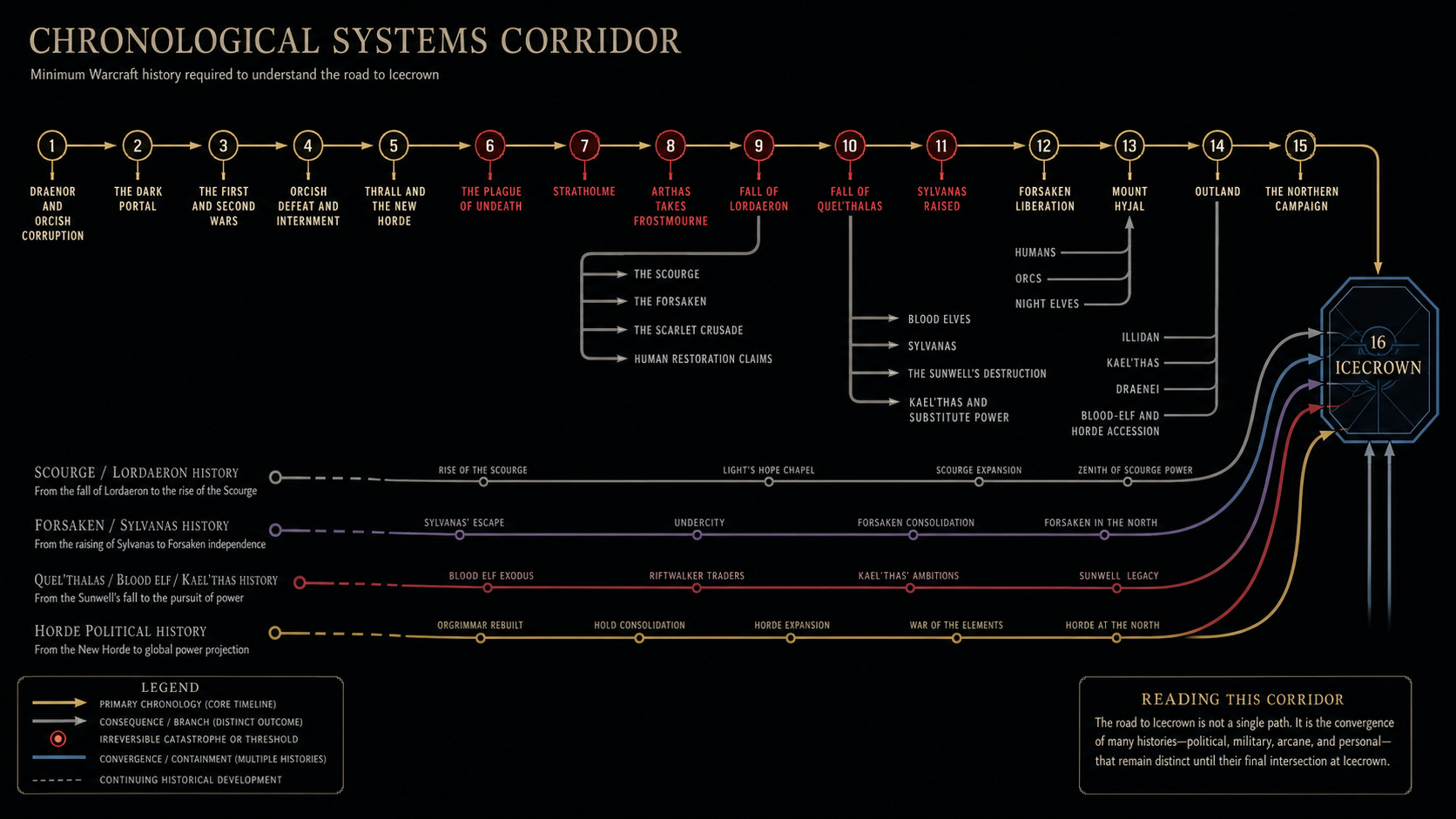
Warcraft begins with an invasion.
Orcish armies cross the Dark Portal from Draenor into the human kingdom of Stormwind. They arrive as the Horde: a coalition of clans driven toward war after demonic powers corrupted their leaders, altered their spiritual traditions, and bound many of their warriors through blood and conquest. Stormwind falls during the First War. The human kingdoms to the north form an Alliance, and the Horde is eventually defeated during the Second.
Many surviving orcs are placed in internment camps. Their armies have been broken, their connection to Draenor has been severed, and the demonic power that once drove them has left many listless and disoriented. They remain responsible for the destruction they caused while only gradually coming to understand how thoroughly they were manipulated.
Thrall is born into the aftermath of that defeat and raised in human captivity. He escapes, encounters the scattered orcish clans, and helps free those held in the camps. He also recovers the shamanic practices that had preceded the Horde’s demonic corruption. After becoming Warchief, he leads his people west across the sea toward Kalimdor, where the orcs hope to establish a future beyond both conquest and captivity.
While Thrall is gathering the remnants of the Horde, another catastrophe begins in Lordaeron, the strongest of the northern human kingdoms.
A plague spreads through shipments of grain. Those who consume it die and rise again as soldiers of the Scourge, an undead army directed from Northrend. Farms become graveyards, towns become recruiting grounds, and every death enlarges the force attacking the kingdom.
Lordaeron’s prince is Arthas Menethil. He is a young paladin trained by Uther the Lightbringer and expected eventually to inherit the throne from his father, King Terenas. Arthas joins Uther and the mage Jaina Proudmoore in investigating the plague. Their pursuit leads them to Stratholme, a major city whose population has already consumed the infected grain.
The citizens are still alive when Arthas arrives, but he believes they will soon become undead. He orders the city purged before that transformation can occur. Uther refuses to obey. Jaina also leaves rather than participate. Arthas proceeds without them.
He follows the dreadlord Mal’Ganis to Northrend, convinced that destroying the demon will end the threat to Lordaeron. There he finds Frostmourne, a runeblade said to possess the power he needs. The sword carries a warning that its wielder will pay a terrible price, but Arthas takes it and uses it to defeat Mal’Ganis.
He does not return home as Lordaeron’s saviour.
Frostmourne has claimed Arthas’s soul and placed him in the service of the Lich King. He murders his father, destroys the kingdom he had sworn to protect, and leads the Scourge across the northern lands.
The Lich King ruling from the Frozen Throne already carries another ruined history. He was once Ner’zhul, an orcish spiritual leader whose actions helped prepare Draenor for corruption and war. After Draenor was shattered, the demon lord Kil’jaeden captured Ner’zhul, stripped away his body, and imprisoned his spirit within a block of ice in Northrend. From there he created and directed the Scourge.
Arthas becomes his principal champion.
The Scourge next invades Quel’Thalas, the elven kingdom north of Lordaeron. Arthas needs the power of the Sunwell, the magical source at the centre of the kingdom, to resurrect the necromancer Kel’Thuzad. His army breaks through the elven defences and reaches the capital.
Sylvanas Windrunner, ranger-general of Silvermoon, leads the resistance. Arthas kills her and raises her as a banshee, forcing her to serve the army that destroyed her homeland. He then uses the Sunwell to restore Kel’Thuzad, corrupting the sacred source in the process.
The surviving elves later call themselves blood elves in memory of those killed during the invasion. Their prince, Kael’thas Sunstrider, seeks new allies and new sources of magical power while attempting to preserve what remains of his people.
Sylvanas remains enslaved until the Lich King’s control weakens. She regains her will and helps other free-willed undead break away from the Scourge. They call themselves the Forsaken and establish themselves beneath the ruins of Lordaeron in a subterranean capital known as Undercity.
The Scourge is only one part of a larger war.
The Burning Legion, the demonic force behind the corruption of the orcs, launches a new invasion of Azeroth. Thrall’s Horde reaches Kalimdor, followed by human survivors led by Jaina. There they encounter the night elves, an ancient people who have guarded the forests of the continent since a magical catastrophe shattered the world thousands of years earlier.
Orcs, humans, and night elves eventually fight together at Mount Hyjal. Their alliance stops the Legion’s immediate invasion, though it does not erase the wars, losses, or suspicions separating them.
Illidan Stormrage also emerges from the night elves’ older history. An exile who has long used demonic power against demons, he becomes involved in the struggle over the Lich King and later travels to Outland, the shattered remains of Draenor.
Outland draws several unfinished conflicts together. Demons occupy parts of the broken world. Corrupted orcs remain there. The draenei, a people pursued across worlds by the Legion, struggle to survive its destruction. Kael’thas and groups of blood elves arrive while searching for power. Illidan establishes himself as ruler of the fractured realm and prepares for further war against the Legion.
These events lead into the world encountered at the beginning of World of Warcraft.
The Alliance and Horde now exist as rival coalitions rather than the armies that fought the first wars. The Alliance includes humans, dwarves, gnomes, and night elves, with the draenei joining later. The Horde includes orcs, tauren, trolls, and Forsaken, followed by the blood elves.
Their rivalries survive because the events that created them remain unsettled. Humans remember the invasion of Azeroth and the destruction of their kingdoms. Orcs remember defeat and internment. Forsaken control territory once belonging to Lordaeron while its living survivors continue to regard the kingdom as their home. Blood elves remember the destruction of Quel’Thalas and the failures of former allies. Night elves confront outsiders settling and extracting resources from lands they have guarded for millennia.
The factions also contain disagreements within themselves. Their members cooperate through necessity, friendship, common enemies, political bargains, and shared dependence. None of the coalitions speaks with a single historical memory or purpose.
Above these conflicts, Arthas waits in Northrend.
After merging with Ner’zhul at the Frozen Throne, he becomes the Lich King in full. From Icecrown Citadel, he rebuilds the Scourge and prepares another war against the living.
When the armies of the Alliance and Horde finally march north in Wrath of the Lich King, they arrive for very different reasons.
Human forces carry the memory of Lordaeron and its murdered king. The Forsaken seek the ruler who killed them and enslaved their minds. Blood elves return to confront the destroyer of Quel’Thalas. The Horde enters a war against a power whose origins reach back into the corruption of the orcs. Paladins and priests organize new campaigns against the undead. Death knights formerly bound to Arthas rebel and form the Knights of the Ebon Blade.
Northrend contains histories older than the Lich King. Titan ruins stand across the continent. An Old God remains imprisoned beneath Ulduar. Dragons guard ancient duties and carry old losses. The Drakkari trolls fight for survival in Zul’Drak. Beneath the ice lie the remains of the nerubian kingdom destroyed by the Scourge.
These armies, ruins, kingdoms, and buried powers occupy the same continent without belonging to one simple conflict. Arthas sits above them wearing the Helm of Domination and commanding an army that turns every casualty into another soldier.
The living climb toward Icecrown expecting an ending as old as heroic story:
Kill the king. Break the sword. Destroy the army.
They will get only part of it.
Act I. The Conditions of the World
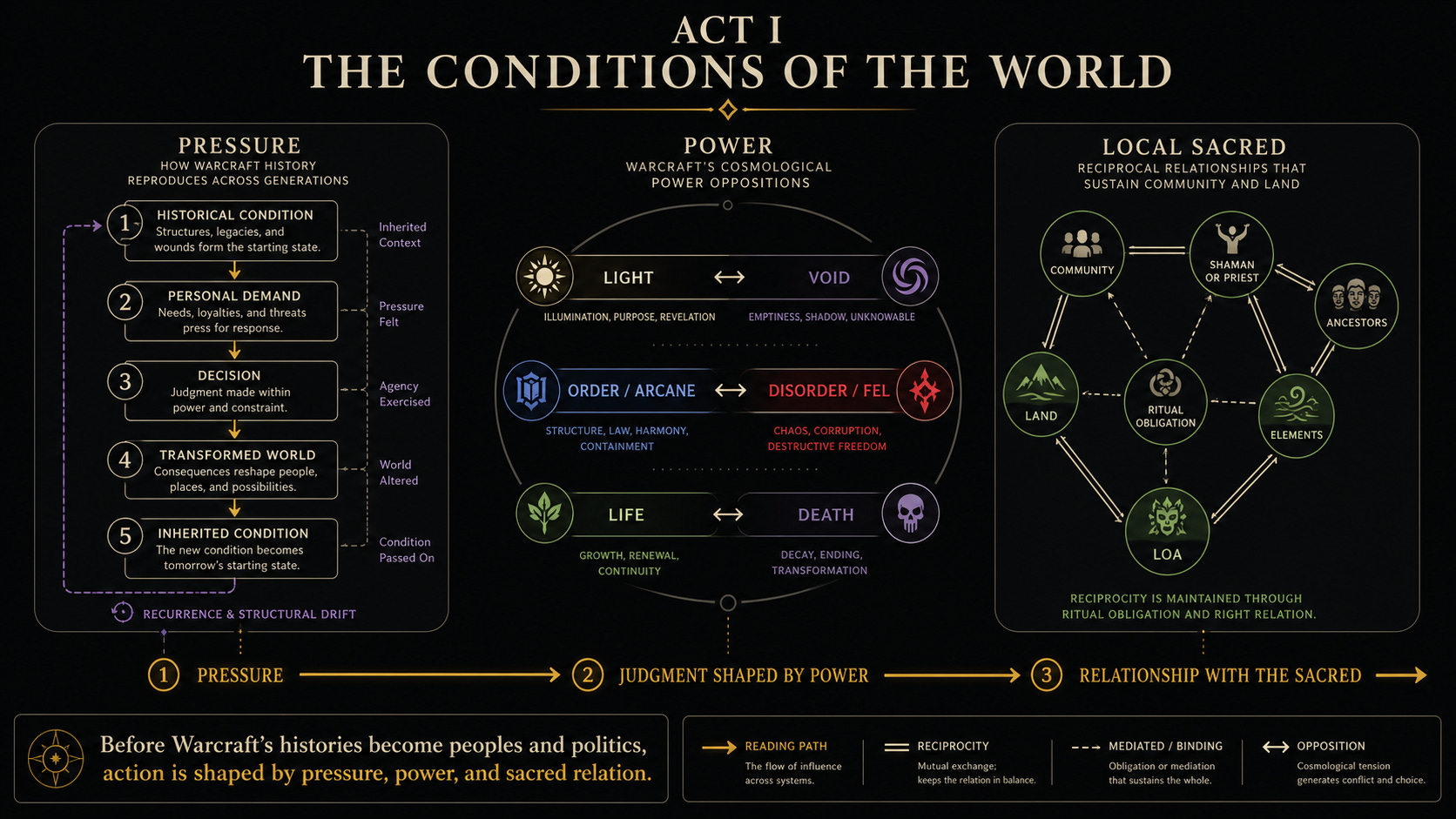
Chapter I. Warcraft Is a Pressure System
Frostmourne enters Arthas’s story after the decisive conflict has already begun.
The plague has made ordinary mercy dangerous. Arthas carries responsibility for a kingdom whose institutions cannot stop the Scourge without confronting the limits of their own authority. Uther’s refusal at Stratholme leaves the prince facing a catastrophe that appears to punish restraint. Jaina’s departure confirms his growing belief that command belongs to whoever accepts the burden of acting alone.
The sword gives that belief material force.
Its power reaches Arthas because duty, fear, pride, and desperation have prepared a place for it. Frostmourne does not invent his desire to save Lordaeron. It joins that desire to a mechanism that steadily destroys his ability to recognize what saving Lordaeron would require.
Warcraft’s strongest stories are built through movements of this kind.
That movement is pressure: not danger alone, but the force created when history, office, obligation, and immediate threat converge upon a choice. Before it changes the world, it changes what the person under it can still recognize as restraint, necessity, or permission.
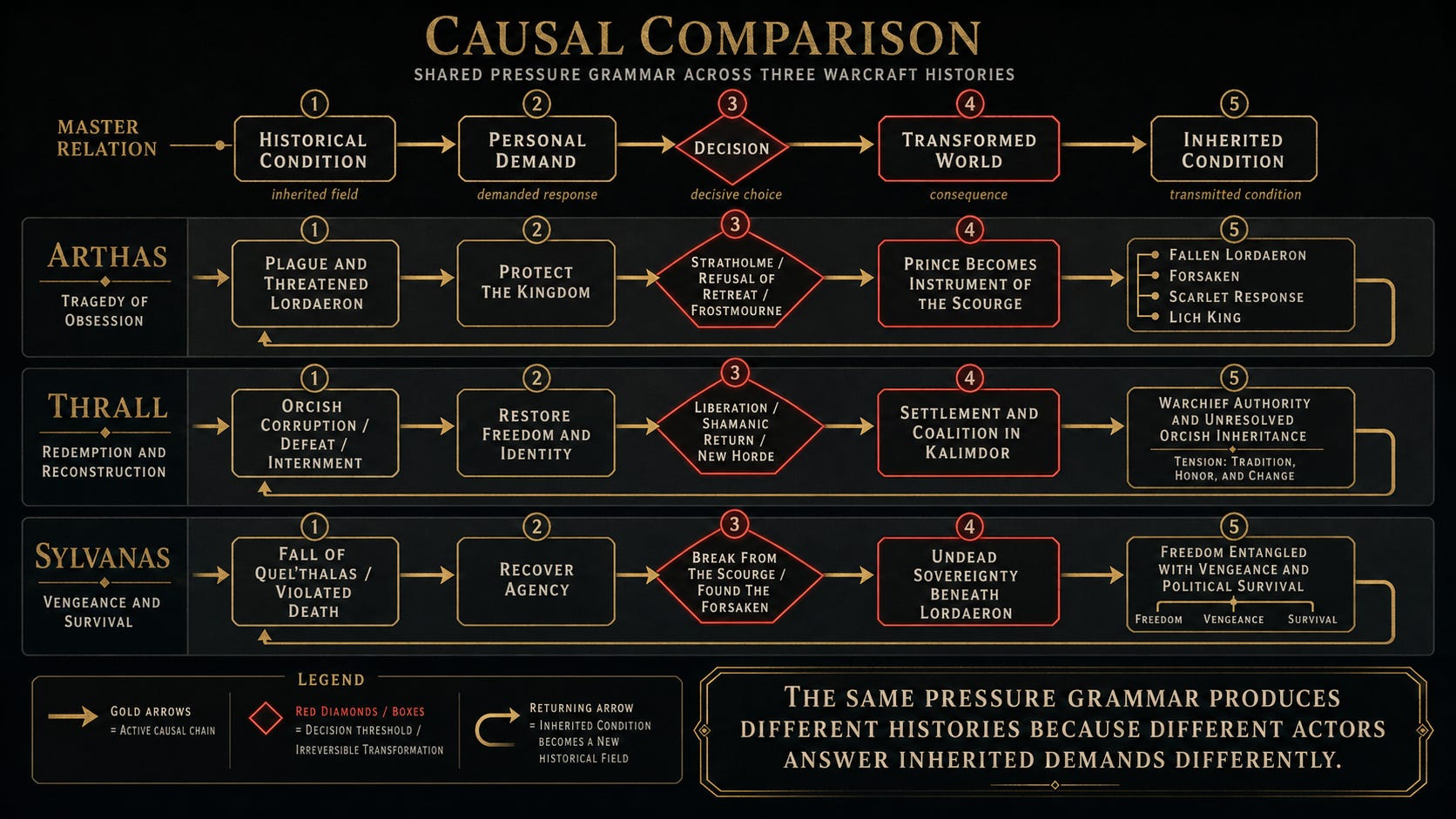
The plague turns hesitation into apparent failure. Arthas’s position as prince makes that failure personally intolerable: Lordaeron’s survival has been placed under his future authority, and every death appears to accuse him of delay. Stratholme converts responsibility into exception. He decides that the scale of the danger releases him from the limits that ordinarily make his authority legitimate.
Northrend removes him from the people and institutions capable of contesting that decision. Frostmourne converts resolve into servitude. His return to Lordaeron turns a private collapse into a dynastic and political catastrophe. The kingdom’s heir becomes its destroyer. Kingship survives as a form of command after every obligation that once justified it has been removed.
Each element alters the meaning of the others. Frostmourne matters because Arthas reaches for it as a prince trying to complete his duty. Lordaeron’s destruction carries a particular force because its own heir performs it. The Frozen Throne completes a movement already present in Stratholme: authority increasingly understood as the right to decide alone whose life may be spent for the survival of the whole.
Arthas occupies several positions at once. He is a son, prince, paladin, commander, student, heir, and protector of Lordaeron. His choices therefore pass through every institution that formed him.
At Stratholme, the duty of protection collides with the moral limits of paladinhood. When Arthas strips Uther of command, he treats institutional resistance as another obstacle to the kingdom’s survival. When his soldiers attempt to return home, he destroys their means of retreat. When Frostmourne warns that its power will scar his spirit, he accepts the cost as though the sacrifice remains his alone to make.
Each decision narrows the field in which the next decision can occur.
His authority becomes more isolated. Retreat becomes less possible. Opposition becomes evidence of weakness. The power required to complete the mission becomes indistinguishable from the mission itself.
The consequences then expand outward.
The betrayal of Muradin corrupts comradeship. The murder of Terenas destroys succession at its source. Lordaeron’s fall turns the deformation of one man into the ruin of a civilization. The Scourge transforms the citizens Arthas once meant to protect into instruments of the power consuming them.
By the time he reaches the Frozen Throne, Arthas has carried the language of inheritance into a form emptied of kinship, mercy, and life.
Pressure has moved between scales:
historical condition → personal demand → decision → transformed world → inherited condition
The final stage gives Warcraft much of its coherence. Catastrophe does not clear the field after the decisive scene. It leaves structures behind.
Thrall inherits one such structure. He does not meet orcish corruption as a temptation offered to an untouched people. He is born after demonic manipulation, conquest, defeat, captivity, and spiritual rupture have already changed what orcish identity can mean. He receives the consequences as the starting conditions of leadership.
His choices cannot return the orcs to the moment before corruption. He must act among people who have known themselves as warriors, conquerors, prisoners, refugees, and weapons. Liberation changes their immediate condition. It leaves the meaning of strength, honour, guilt, and collective responsibility unresolved.
Sylvanas receives the consequences of Arthas’s choices from another position. She escapes the Lich King’s command, yet freedom does not restore her body, former life, homeland, or place among the living. The structure that enslaved her loses direct control without losing its effect upon the conditions of her existence.
Her liberation therefore creates another demand. She must decide what agency can mean after identity has been preserved inside a form imposed by an enemy.
Arthas, Thrall, and Sylvanas reveal three points in the same movement.
Arthas receives a historical obligation and returns it to the world as catastrophe.
Thrall inherits catastrophe and attempts to create collective life within its consequences.
Sylvanas escapes one of the structures produced by that catastrophe while remaining marked by its terms.
These characters do not express a shared theme in different costumes. They occupy different positions inside a causal system. One decision produces the world another character must interpret.
Warcraft’s continuity depends heavily upon this persistence. A ruler dies while the kingdom remains ruined. A war ends while displaced peoples continue to live under its terms. An emergency produces an institution that survives the emergency. A weapon changes hands while preserving the bargain built into its use. Later characters inherit decisions they never made and responsibilities they did not choose.
The world remembers by changing the conditions of action.
This form of coherence does not require an immaculate canon. Warcraft grew through games, manuals, novels, quests, cinematics, expansions, revisions, and the work of many creators. Its history contains altered dates, expanded origins, repaired contradictions, and meanings discovered after the images carrying them were created.
Factual consistency and structural coherence remain distinct tests.
A revision can change the chronology of an event while deepening the burden inherited from it. Another can preserve every date and proper noun while severing the relation that gave the event force.
The useful question is:
Does the addition place meaningful new pressure upon what already exists?
Does a new origin deepen the demand carried by a character? Does a revelation intensify the conflict inside an institution? Does the added history change what a people must remember, justify, or overcome? Do the old and new elements become more causally connected?
A coherent addition enlarges the field of consequence.
The same principle explains why Warcraft repeatedly opens tragedy through legitimate needs. Arthas wants to protect Lordaeron. The orcs seek strength and freedom. The blood elves seek survival after devastation. Holy orders seek to protect the living from a concealed plague.
The need gives the destructive answer its credibility. Deformation begins when one demand acquires enough authority to subordinate every competing obligation.
Protection can make restraint appear irresponsible.
Strength can make dependence appear like liberation.
Restoration can make a new dependency appear temporary.
Vigilance can make indiscriminate violence appear necessary.
These are the beginnings of recurring story patterns that will become visible later. Here they establish one final property of pressure: it enters through a person’s understanding of the crisis.
Power does not meet a neutral mind. It encounters an existing judgment about what matters, what has become intolerable, and what the situation now permits. Different powers confirm different judgments. They reward particular forms of conviction, appetite, mastery, suspicion, continuity, and command.
The next layer begins with those habits of perception: the moral posture carried by power, and the kind of person a power teaches its wielder to become.
Chapter II. Power Carries Moral Posture
A power begins shaping its wielder when it teaches them what the crisis means.
Arthas reaches Frostmourne after Stratholme has already narrowed his judgment. Delay has become complicity. Mercy appears irresponsible. Opposition confirms that others lack the will to accept necessary costs. The sword offers strength, but its deeper promise is agreement. It tells him that victory belongs to whoever can act without permission.
Power in Warcraft works through this kind of instruction. Its great forces do more than grant abilities. They cultivate habits of perception: what deserves protection, which dangers must be eliminated, whose suffering counts, and what may be sacrificed to prevent a greater loss.
Each answers a genuine mortal need. Conviction, doubt, mastery, appetite, renewal, and finality cannot simply be dismissed as corruption.
The danger begins when one capacity becomes a complete account of reality.
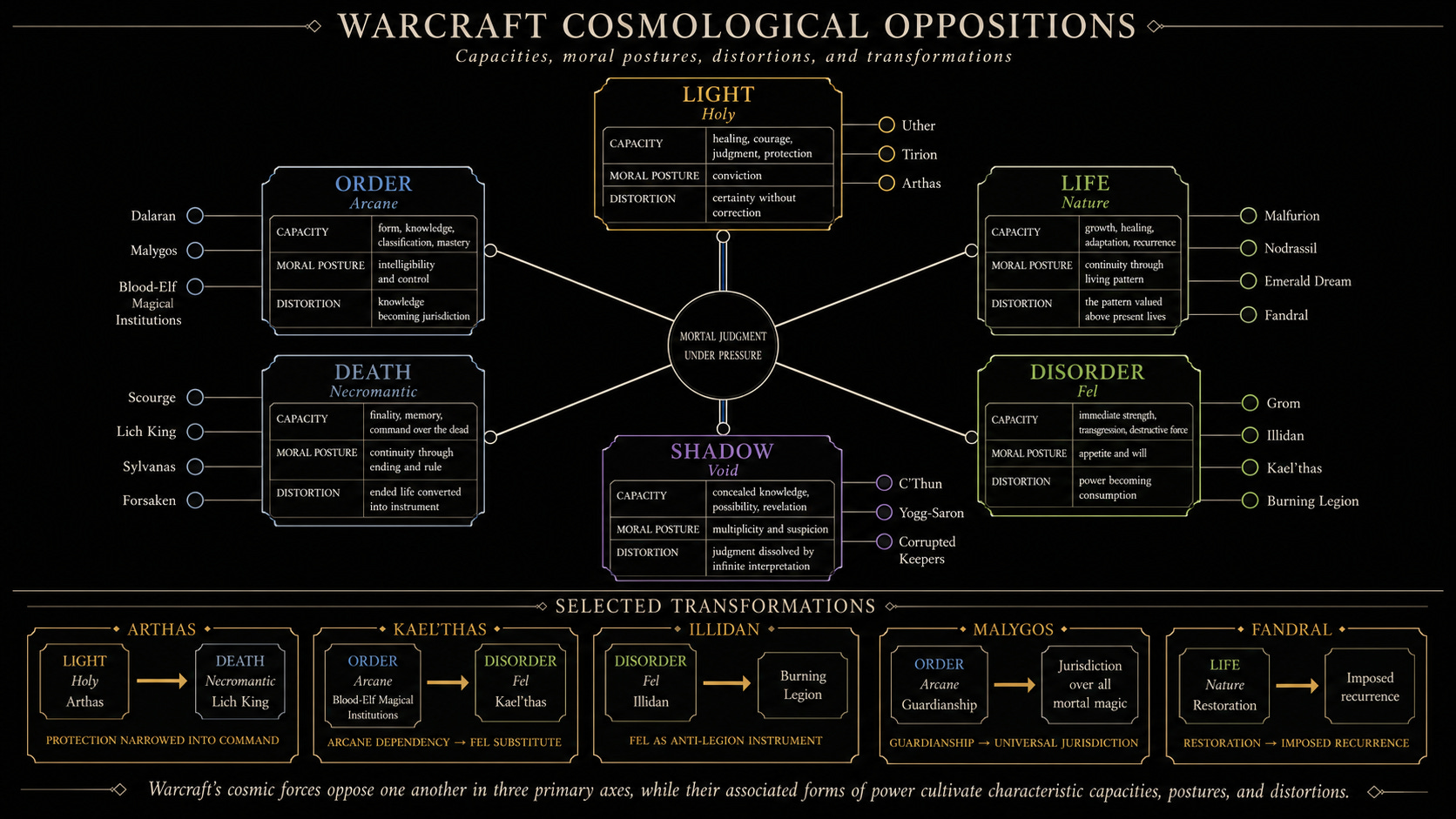
Warcraft’s cosmology names six broad forces arranged across three oppositions: Light and Shadow, Order and Disorder, Life and Death. Mortal beings encounter these forces through more particular magical expressions: Holy power and the Void, Arcane and Fel, Nature and Necromancy. The first terms name the cosmic axis; the second name the forms through which that axis most often enters history and individual action.
Light and Shadow — Holy and Void
The Light gives moral conviction visible force. Wounds close beneath it. Darkness recedes before it. Goodness becomes capable of acting upon the world rather than remaining a private intention unable to resist evil.
Uther embodies that promise through restraint. His strength remains answerable to service, fellowship, and limits that command cannot suspend. Tirion preserves the same relation after the institutions surrounding the Light reject him. His exile separates faith from institutional approval. Conviction survives because he does not identify it completely with either his own authority or the authority of those who claim to speak for it.
Stratholme exposes the pressure inside that confidence.
The city has consumed infected grain. Its population may soon become an army of the dead. Waiting risks releasing the plague. Killing the citizens requires Arthas to destroy those he has sworn to protect.
Uther refuses because some commands destroy the moral authority by which they are issued. Arthas reads the same refusal as an abandonment of responsibility. He has been formed to believe that goodness must possess the courage to act, and the emergency appears to prove that restraint has become cowardice.
He chooses certainty.
The possibility of catastrophe becomes sufficient authority for an irreversible decision. Resistance becomes evidence that others cannot bear the demands of leadership. Arthas reduces the Light’s moral inheritance to one imperative—protect the kingdom—and severs that imperative from humility, fellowship, and the possibility of his own error.
Frostmourne enters through the opening left by that reduction.
The Scarlet Crusade turns the same posture into an institution. Its fear is grounded in experience: neighbours have become enemies, corpses have risen as soldiers, and infection may remain hidden inside a familiar body.
Vigilance therefore carries moral weight. Under sustained pressure, vigilance becomes suspicion. Suspicion becomes purity. Purity authorizes violence against anyone whose humanity cannot be established beyond doubt.
The Crusade continues fighting for the living after losing the capacity to recognize them.
The Light’s danger lies within the virtue that makes it necessary. Conviction gives judgment the strength to act. It can also place judgment beyond correction.
The Void attacks the same faculty from the opposite direction.
Its whispers multiply possible meanings. A trusted face may conceal betrayal. An institution may serve a purpose opposite to the one it announces. A harmless choice may prepare a disastrous future. Every surface acquires another layer beneath it.
The horror lies partly in the possibility that some of these revelations are true.
C’Thun and Yogg-Saron do not need to invent every fear they awaken. They speak through suspicions, ambitions, memories, and private injuries already present in the listener. The alien voice becomes difficult to distinguish from one’s own thought because it uses material the mind recognizes as its own.
The Void offers depth without orientation. It reveals hidden motives and competing possibilities while dissolving the means by which one perception might be judged against another.
Once every appearance may conceal another meaning, trust becomes negligence. Every certainty looks like a trap. Every denial may appear to prove the suspicion it rejects.
The Light can make judgment unquestionable. The Void can make judgment impossible.
Conviction without humility becomes tyranny. Suspicion without trust becomes paralysis.
Order and Disorder — Arcane and Fel
Arcane and Fel answer a different mortal condition: helplessness before powers that exceed ordinary limits.
The Arcane answers through form.
Magic becomes something that can be studied, measured, classified, taught, stored, and directed. Intelligence acquires material force through towers, libraries, geometries, portals, vaults, and institutions capable of altering the world.
Dalaran embodies this confidence. Mystery can be investigated without being worshipped. Danger can be contained without being obeyed. In a world governed by ancient beings and catastrophic forces, disciplined knowledge allows mortal intelligence to refuse helplessness.
Understanding also creates authority.
A mage who knows how a force operates has real grounds for regulating its use. Magical recklessness can destroy cities, summon invaders, or rupture boundaries that others must then defend. Systems and laws answer dangers that ignorance would leave untouched.
The posture changes when expertise becomes jurisdiction.
Malygos sees the scale of the destruction caused by mortal magic. Charged with protecting the Arcane, he concludes that mortals can no longer be trusted with it and begins redirecting the world’s magical currents away from them.
His knowledge reveals a genuine danger. It also encourages him to treat his own judgment as the natural boundary of everyone else’s freedom. Stewardship expands into ownership. The guardian claims the right to decide who may touch the power he was appointed to protect.
Arcane mastery becomes dangerous when the system succeeds so completely that everything outside it appears irresponsible.
Fel answers helplessness by destroying the distance between desire and force.
Its promise is immediate. Weakness can end now. The enemy can be overwhelmed before patient learning, alliance, or restraint has had time to fail. Power enters the body directly and makes hesitation feel obsolete.
Mannoroth’s blood exploits capacities the orcs already possess: courage, martial strength, clan loyalty, ambition, and the desire to defend themselves against enemies they have been taught to fear.
Fel does not replace those qualities. It seizes and redirects them.
Fury becomes possession. Victory deepens servitude. Strength proves itself through obedience to an appetite planted by another will.
The orcs believe they are overcoming vulnerability while becoming instruments of a force that depends upon their inability to stop consuming what it offers.
Grom Hellscream breaks that relation because he knows its exhilaration from within. His final attack upon Mannoroth turns the force of his compromised life against the being who made compromise feel like liberation.
His sacrifice ends the curse without restoring innocence. Freedom interrupts the command. It does not erase the actions performed under it.
Illidan reaches Fel through usefulness rather than submission. Faced with enemies whose power exceeds conventional means, he treats demonic force as material that can be absorbed and redirected. Contamination becomes a weapon against its source.
The logic possesses real force. Refusing a dangerous weapon may leave the world defenceless against an enemy with no comparable restraint.
But Illidan’s willingness to bear corruption gradually becomes a source of authority in his own mind. Because he has sacrificed more, he assumes he can see further. Because ordinary judgment cannot measure what he has endured, he begins to believe it cannot measure what he is entitled to do.
The willingness to pay a price becomes the presumed right to decide which prices others must pay.
Fel makes transgression effective. Effectiveness begins to vindicate transgression.
Arcane and Fel both promise mastery over conditions that make ordinary action feel inadequate. The Arcane builds systems capable of containing power. Fel burns through the limits obstructing its use.
One risks turning knowledge into universal jurisdiction. The other turns appetite into proof of necessity.
Life and Death — Nature and Necromancy
Life and Death exert their pressure upon time itself.
Life places mortal events inside rhythms of growth, decay, dormancy, and return. Forests recover from fire. Roots cross borders established by kingdoms. A wound that appears final within one lifetime may close across centuries.
This scale gives Life both its consolation and its severity.
At Mount Hyjal, the night elves help defend Nordrassil against Archimonde and the Burning Legion. The world survives, but the damage to the World Tree ends the immortality that had shaped night-elven civilization for thousands of years.
Victory leaves a condition that cannot be defeated in battle: the end of continuity.
Fandral Staghelm plants Teldrassil in an attempt to restore what has been lost. The new World Tree promises permanence through deliberate renewal, but the desire to recover the former condition outruns the relationships that once sustained it.
Restoration becomes an effort to compel recurrence.
Life’s danger appears when continuity acquires authority over the present. Renewal may preserve a pattern while ignoring whether the present world still supports its return. Contemporary lives and losses become temporary obstructions inside a process larger than any individual claim.
A force ordered toward continuity does not measure cost as mortals do. It may heal the world by returning it to an arrangement the people now living within it never chose.
Death establishes the boundary that recurrence cannot cross. A life ends. Obligations change hands. The body passes beyond command. The dead can no longer be made to serve the ambitions of the living.
Necromancy violates that boundary by making the dead useful.
Bodies return as labour, soldiers, experiments, and extensions of another will. The horror of the Scourge lies in the organization of this violation. Death acquires ranks, supply lines, laboratories, fortresses, and policy.
A corpse is denied burial because administration has found another use for it.
Sylvanas experiences this seizure in its most intimate form. Arthas kills her, pulls her spirit back into service, and leaves her conscious within the destruction of her body and homeland. Memory survives while the life that gave memory its shape becomes impossible to resume.
The victim loses the final refusal that death should provide. The self remains available to the power that destroyed it.
The Scourge extends that violation into sovereignty. Its army grows through every death it causes. Defeat becomes recruitment. The dead possess no territory, privacy, or final boundary beyond which command can no longer reach them.
Life can subordinate the present to recurrence. Necromantic Death subordinates finality to use.
Both exceed the timescale of ordinary mortal judgment. Their corrupted forms arise when one relation consumes the other: continuity refuses to accept loss, or command refuses to accept an ending.
Warcraft’s powers become persuasive because refusing them carries danger.
Arthas can preserve moral restraint only while risking the spread of the plague. The orcs can reject Mannoroth’s blood while remaining exposed to enemies and ambitions that make strength attractive. Illidan can reject Fel while leaving useful weapons in the hands of the Legion. Malygos can tolerate mortal freedom while accepting the destruction mortals may cause. Fandral can accept the end of immortality while watching his civilization enter a diminished future.
Necessity gives each posture its opening.
Power then teaches the character to interpret more of the world through the faculty that first made it attractive.
Conviction becomes the answer to uncertainty. Suspicion becomes the answer to deception. Mastery becomes the answer to helplessness. Appetite becomes the answer to limitation. Recurrence becomes the answer to loss. Command becomes the answer to death.
The original need remains genuine. The danger lies in allowing its answer to become universal.
These forces do not exhaust Warcraft’s sacred life. Beyond their broad tendencies stand powers encountered through particular relationships: ancestors with claims upon descendants, elements that can refuse a request, spirits attached to territories, and Loa whose names, appetites, memories, and bargains belong to specific peoples.
Here power does not appear first as a universal principle, but as a presence that must be addressed.
Chapter III. The Local Sacred
A mage studies the world until its patterns yield to method. A warlock acquires power through appetite and bargain. A paladin commits to a sacred charge and acts beneath its judgment.
In Warcraft, the first act of a shaman is to listen.
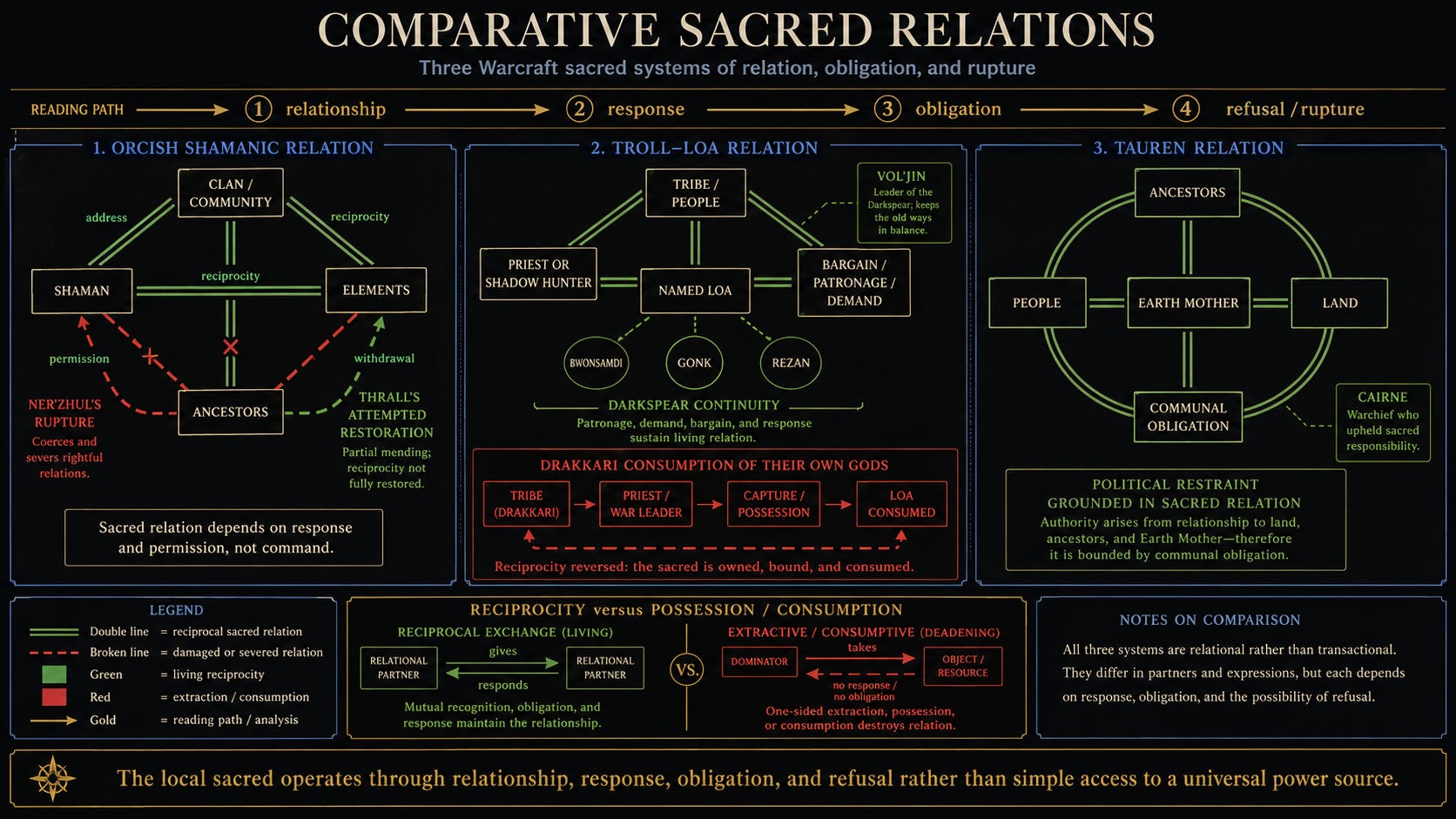
The shaman sees and hears a world that speaks. Stone, flame, storm, water, ancestor, and wounded land are neither mute substances nor reservoirs awaiting use. They possess character, memory, and the capacity to refuse. Power must be requested, answered, and sustained inside a relationship.
That difference keeps Warcraft’s cosmology from hardening into a diagram.
Universal forces describe broad tendencies within creation. They can tell us why certain powers encourage conviction, mastery, appetite, uncertainty, recurrence, or command. They cannot exhaust the sacred meaning of a burial ground, a river crossing, a hunting rite, or a mountain associated with the dead. Shamanism, elemental spirits, ancestors, and Loa return metaphysics to particular places and histories.
They give mystery an address.
A Loa has a name. An ancestor carries a remembered life. An element may bear the injuries of the land it inhabits. These presences cannot be understood through capacity alone. Their meaning includes the people who approach them, the terms under which they answer, the obligations created by earlier exchanges, and the possibility that the relationship has been damaged.
For the orcs, shamanism survives as a lost inheritance.
Before demonic corruption and the machinery of conquest, life on Draenor was ordered through clan loyalty, ancestral memory, elemental presence, and ritual obligation. That earlier world was neither gentle nor innocent. Orcish society was martial, severe, and shaped by danger. Its importance lies in the limits that relationship placed upon strength.
Violence remained answerable to clan, land, and the dead. Power belonged to a living order in which the seen and unseen retained claims upon one another. A warrior could possess great strength without imagining that strength existed apart from the world sustaining it.
The turn toward Fel therefore destroys more than a religious practice. It severs a way of inhabiting the world.
Listening gives way to appetite. The elements withdraw. Ancestral guidance is replaced by commands issued by powers with no stake in orcish memory. Clan strength is reorganized into a military instrument whose spiritual context has been removed. A people once bound to its land and dead becomes useful to an intelligence that wants force detached from obligation.
The military catastrophe follows from the sacred rupture.
Ner’zhul stands at its centre. His tragedy depends upon the authority he once held as a mediator between his people and the unseen. Kil’jaeden does not first approach him as an obvious conqueror. He exploits the form in which guidance is expected to arrive.
Ner’zhul believes he is receiving knowledge through ancestral authority. The message confirms his fear that the draenei threaten the orcs. Revelation becomes deception without immediately changing its outward form. Trust in the dead is redirected against the living.
This exposes the first danger within relational power. Listening does not guarantee truth. A relationship can be manipulated precisely because the listener has learned to trust the form through which guidance comes. Intimacy creates obligations and vulnerabilities together.
Ner’zhul recognizes the deception after his authority has already helped set the clans in motion. His later fate carries the inversion further. A spiritual leader who once interpreted the unseen on behalf of his people becomes part of the Lich King, a power that abolishes the independence of every person placed under its command.
Mediation collapses into domination.
Thrall’s return to shamanism acquires its weight against that history. His spiritual practice is not an ornament attached to political leadership. It is an attempt to repair the conditions under which orcish strength can be trusted.
Strength alone cannot restore the orcs because strength was the faculty through which they were enslaved. Guilt cannot restore them either. A people cannot create a future by endlessly rehearsing its disgrace.
Shamanism gives Thrall another relation to power. Listening answers appetite. Memory interrupts possession. The elements place judgment outside the desires of the wielder. When Thrall calls upon them, the answer cannot be assumed merely because his intention appears righteous to him.
Power remains conditional. This condition gives shamanism its practical humility. The shaman may possess knowledge, authority, and urgent need. The spirit may still refuse. The refusal matters because it prevents desire from becoming its own justification.
The tauren locate the sacred through land, ancestry, hunting, and the cycles sustaining communal life. Their traditions make survival answerable to the world that enables it. The animal killed for food, the earth crossed during migration, and the dead whose instruction remains within the tribe all place limits upon what strength may claim.
Cairne Bloodhoof’s authority grows from this slower measure. His strength does not need constant demonstration because it remains embedded in kinship, memory, and responsibility. He represents power whose legitimacy depends upon what it preserves around itself.
Rootedness carries its own danger. A relationship to land can become a refusal to recognize that history has changed the people living upon it. Ancestral authority can protect a community from appetite while also placing inherited judgment beyond argument. Tradition can preserve knowledge earned across generations, then make the claims of the dead heavier than the needs of the living.
The local sacred does not escape the problem of power. It changes its form.
Among the trolls, sacred relationship becomes more openly transactional. Their world is crowded with Loa associated with animals, territories, death, protection, cunning, hunger, and tribal memory. These powers intervene directly. They grant favour, demand service, punish betrayal, and pursue appetites of their own.
A bargain with a Loa never becomes safe merely because it is sacred.
Drums, masks, blood, shrines, and animal forms are the material language of a people living among powerful presences. The Loa cannot be reduced to distant symbols of natural principles. They act within troll history and remain entangled with particular tribes, territories, rulers, and grievances.
Their proximity preserves old claims. A shrine can hold the memory of a people whose empire has fallen. A Loa may remember an obligation that the living would prefer to abandon. Sacred presence allows history to answer back.
It may also demand more than its worshippers can safely give.
The Drakkari of Zul’Drak expose the collapse of reciprocity under existential pressure. The Scourge is destroying their kingdom. Their gods have not delivered them from extinction. The Drakkari respond by killing their own Loa and consuming their power.
The act follows the same logic that appears wherever necessity overwhelms relationship: what once possessed a claim upon the people becomes a resource for their survival. The gods are stripped of presence and reduced to capacity. Worshippers take by force what could no longer be secured through bargain.
The inversion is complete. A people destroys the sacred beings through whom its history, territory, and identity had remained alive in order to preserve the biological remainder of that people. Survival becomes the only measure, even when the method of survival consumes what made survival meaningful.
The Drakkari do not abandon religion for secular calculation. They retain belief in the Loa’s power while abolishing the relationship that made the power sacred. They know the gods are real. That knowledge makes them worth harvesting.
The local sacred therefore contains its own form of corruption. Reciprocity can become extraction. Obligation can become coercion. Reverence can become fear of powers whose appetites cannot be reconciled with human flourishing. A people may remain bound to a presence long after the relationship has ceased to sustain them.
Vol’jin offers another troll response to displacement and sacred inheritance. The Darkspear survive the loss of their islands without treating survival as permission to sever every older relation. Their Loa, rituals, and dead travel with them. Place matters, yet the sacred life of the people cannot depend upon permanent possession of one territory.
Vol’jin’s patience grows from this history. He leads a tribe accustomed to loss, exile, and the need to judge alliances carefully. Listening becomes political intelligence without becoming reducible to strategy. He allows memory to inform action while refusing to let grievance dictate every action in advance.
Ancestral presence carries similar intimacy.
A cosmic force presses upon the person as a tendency within existence. An ancestor presses through a known name, kinship, remembered conduct, and unfinished obligation. The dead remain capable of guiding the living because the relationship did not begin with death.
That intimacy gives ancestral authority its moral force. The ancestor may remind descendants of promises, betrayals, duties, or identities that immediate convenience has obscured. The past becomes capable of contesting the present.
It can also burden the present with conflicts whose original conditions have disappeared. The living may become responsible for preserving a grievance they did not create or obeying an authority they cannot question directly. A false ancestral voice may exploit obligations that genuine memory has made powerful, as Ner’zhul discovered.
The elements are equally intimate because they make the physical world responsive without making it tame.
Fire, water, earth, and air bear dispositions shaped by place, injury, and relation. They may answer a call, reject it, or react to damage inflicted upon the world they inhabit. Elemental disorder signifies more than technical imbalance. It reveals a damaged relation among living beings, spiritual powers, and land.
Shamanism locates consequence inside the act of taking. The river does not become morally pure because it can speak. The storm does not become benevolent because it can answer. Addressed power remains dangerous. Its importance lies in preserving encounter. The wielder must face something whose existence and judgment do not collapse into their own intention.
This is why Warcraft loses depth when these traditions are treated as decorative expressions of a universal system.
A Loa is not simply Life wearing a troll mask. An ancestor is not merely an undead being rendered acceptable by custom. Shamanism is not a provincial interface for elemental mechanics. Such descriptions may identify part of what these beings are made from. They do not explain the relationships through which those beings become sacred.
Different peoples encounter mystery through forms created by their histories, territories, covenants, and dead. The distinctions matter because each relation asks something different of the living.
The orc listens for elements that withdrew during an age of corruption. The tauren places strength beneath the judgment of land and elder memory. The troll bargains with powers whose favour cannot be separated from appetite. The ancestor speaks from a past that retains claims upon the present.
These relations determine how a body is buried, how food is taken, how authority is justified, how land is inhabited, and which obligations remain binding after their origin has been forgotten.
Sacred relationships do not remain inside shrines.
Repeated long enough, they enter custom, kinship, law, leadership, territorial claims, and collective memory. A way of addressing the unseen becomes a way of organizing life among the living. Ritual becomes habit. Habit survives the event that produced it. Memory begins to govern people who were not present at its beginning.
At that point, metaphysics has entered history.
The next scale is civilization: the form a people gives to what it has inherited, lost, survived, and learned to hold sacred.
End of Act I
You have reached the end of The Conditions of the World.
Act II — History Takes Form
Chapter IV: The Wound Becomes a People
Continues next week.
Very neat break down of the lore. I watched Platinum wow funny lore videos, found some of Wow lore compelling others like forced content evil of the week.
But seeing the actual impact analyzed and showing the continued affects of each new development is great, no return to status quo.
Looking forward to the next one