

Warcraft: The Structure Beneath the Lore, Act II
A whole-world reading of how power becomes history—and history becomes inheritance—on the road to Icecrown.
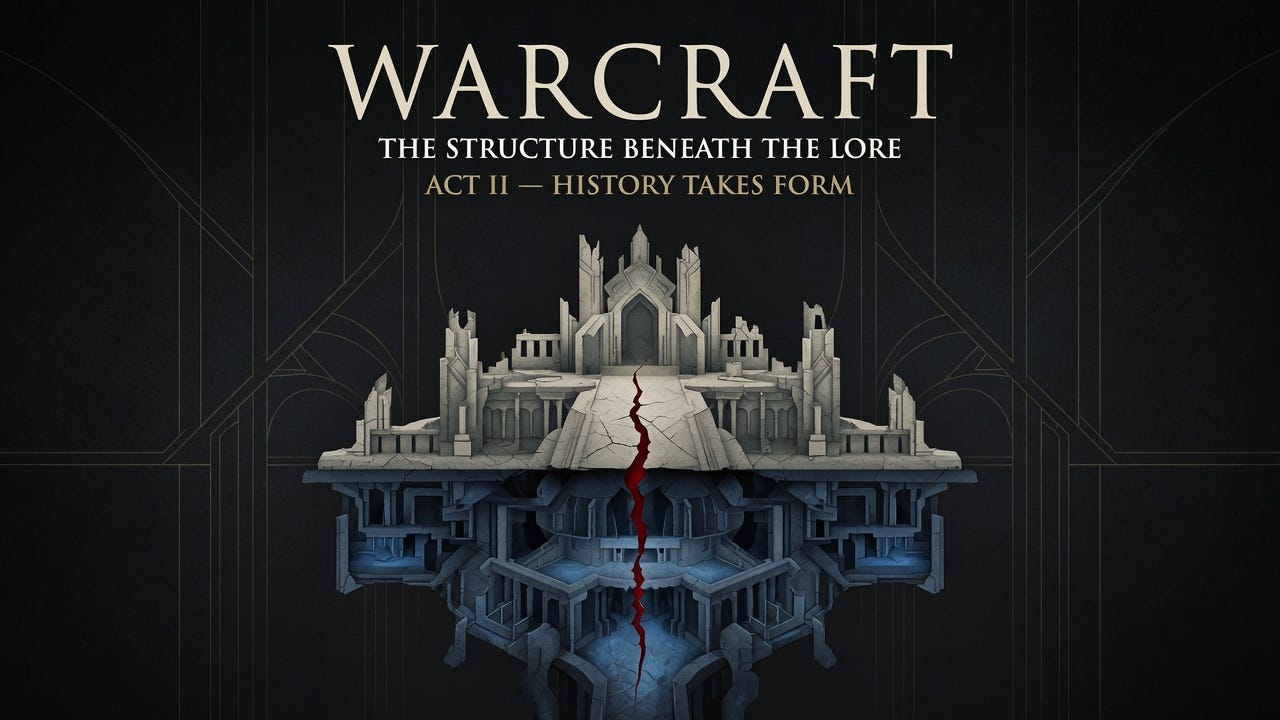
This is the second part of Warcraft — The Structure Beneath the Lore.
Act I establishes the method behind everything that follows: how Warcraft’s powers shape judgment, how pressure enters character and history, and how the elements, ancestors and Loa keep its sacred world rooted in particular relationships.
Act II — History Takes Form
Roughly two weeks ago, the first part of this essay began with a man seated on the Frozen Throne and then moved away from him—down through the forces and relationships that make Warcraft’s world cohere.
Act I established the basic method. Warcraft’s powers are more than sources of magic. They cultivate habits of judgment.
The Light encourages conviction;
Fel promises strength through consumption;
Death turns what should have passed beyond use into something that can still be commanded.
Beneath those larger forces, the elements, ancestors and Loa reveal a more local sacred world built through attention, obligation and response.
This second act follows what happens after those relations enter history.
A power can shape the way a person sees. A decision made through that vision can destroy a kingdom, liberate a people or leave a wound that survives everyone who first experienced it. Later generations inherit the consequences as customs, institutions, loyalties, suspicions and claims upon the world.
This is where we resume. We will begin with civilizations: the different forms of life built after catastrophe made return impossible. From there, we will follow those peoples into the Alliance and Horde, where one civilization’s memory becomes another’s political obligation. Finally, we will return to the characters standing inside these histories as the points where several legitimate demands collide and something must be sacrificed.
IV. The Wound Becomes a People
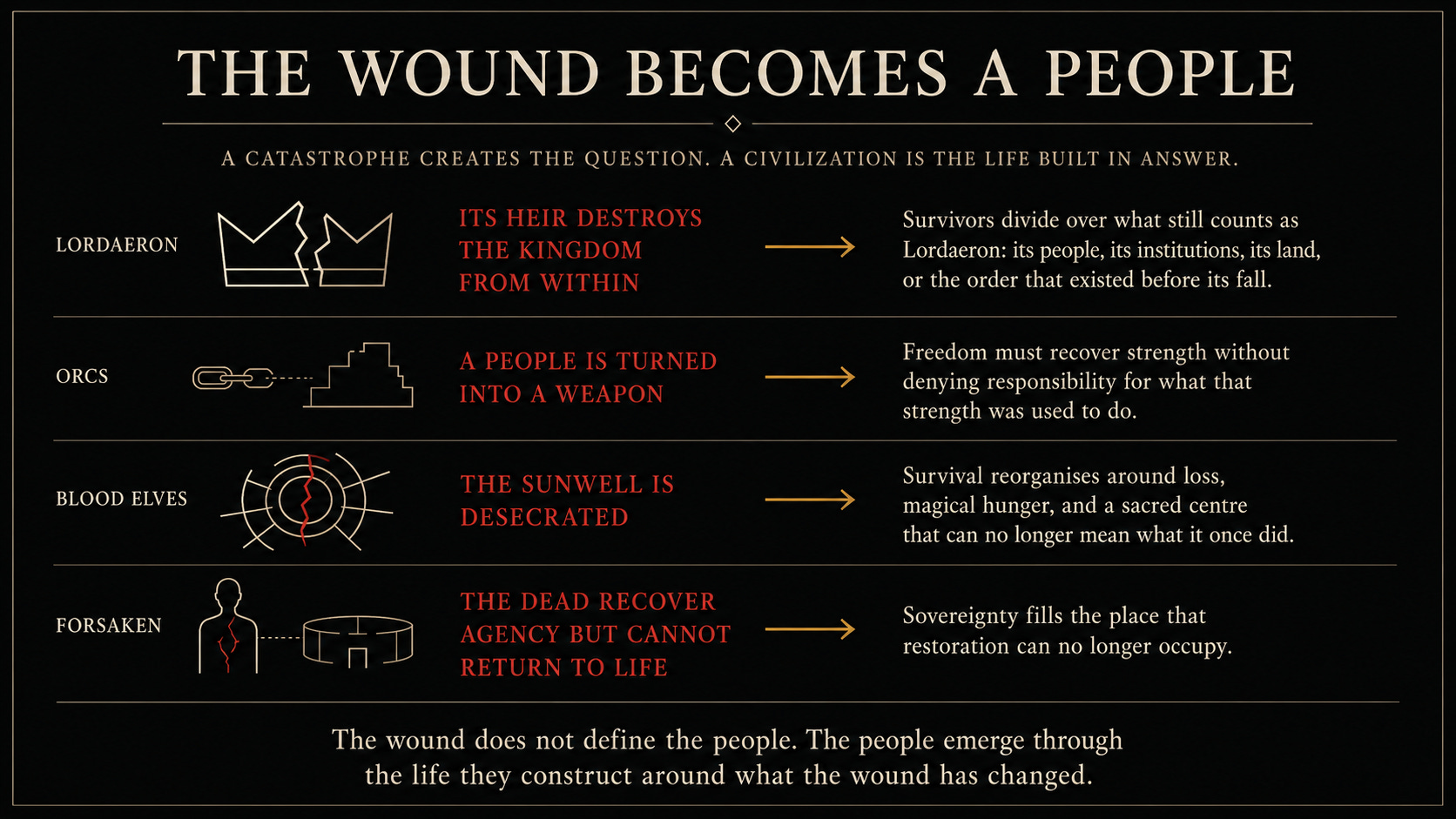
Lordaeron survives its destruction in several incompatible forms.
It remains a fallen kingdom whose living heirs still imagine restoration. It remains a sacred and political order whose institutions outlived the crown they were built to serve. It remains the homeland of people who died there, returned in altered bodies and now occupy its ruins under a different name. The kingdom has been destroyed, but its history has not become past. It continues through competing claims over what Lordaeron was, who still belongs to it and what must now be preserved.
Before Arthas, the kingdom had imagined continuity through institutions that appeared to reinforce one another. The crown passed political authority through bloodline. Paladin orders joined force to sacred discipline. Church, law and monarchy allowed Lordaeron to believe that legitimate rule would survive the death of any particular ruler. Arthas destroys that confidence from the position meant to preserve it. He is not a foreign conqueror. The heir himself carries succession into the acts that make succession impossible. A paladin commands the dead; a son murders the king from whom his authority descends; the protector turns the population of his kingdom into material for the power consuming it.
Those who survive cannot agree on what restoration would mean. The royal line has betrayed its own purpose. Sacred authority failed to restrain the heir. Much of the population has been killed, displaced or transformed. The land remains, but no single institution can still stand for the kingdom as a whole. Some locate continuity in surviving law and orders. Others treat the recovery of land and lineage as justice owed to the dead. The Scarlet Crusade answers the ruin by making the boundary around the living ever more severe. Because undeath can hide inside a familiar body, familiarity itself loses its claim upon mercy. An attempt to preserve Lordaeron’s humanity begins consuming the human beings in whose name it acts.
The catastrophe creates no single identity. Instead, it creates a dispute over what must now be carried forward. Blood, territory, faith, institutions and displaced populations all retain claims upon the name of Lordaeron, but the agreement that once held them together has been destroyed. The kingdom persists as a field of competing continuities.
The orcs inherit the reverse problem. Lordaeron’s survivors must decide how legitimate continuity can persist after its institutions have collapsed from within. The orcs must decide which continuities remain legitimate after their strength has served another will. Demonic corruption does not erase the wars fought through it. Defeat and internment equally do not turn conquest into innocence. Yet guilt alone cannot explain a people whose spiritual life was manipulated, whose clans were redirected into military machinery and whose warriors were taught to experience possession as strength.
Any recovered orcish identity therefore must hold violation and responsibility together. A return to strength can become liberation from shame, but strength was the faculty through which the Legion made the orcs useful. For the orcs, Clan memory preserves relations older than corruption while tempting the survivors toward an untouched past that no longer exists.
Grom, Ner’zhul and Thrall each carry different answers to that inheritance. Grom embodies the exhilaration of corrupted power and the possibility of turning it against its source. Ner’zhul allows spiritual authority to become the route through which another intelligence enters his people. Thrall restores shamanic relation while taking up the office of Warchief, joining a form of power that must listen with one built to command.
Honour becomes increasingly important for the Orcs because it tries to distinguish strength from possession. It asks whether power can be exercised without surrendering its purpose to appetite, domination or the need to prove itself. Thrall’s answer cannot declare the orcs innocent, but neither can it allow their future to remain a punishment administered by their enemies.
The orcs eventually build their new homeland in Durotar, a harsh stretch of Kalimdor chosen after captivity and exile. The land there offers no fantasy of simply going back. Draenor is gone, the old Horde cannot be restored, and freedom does not erase what the orcs did while corrupted. Durotar becomes the place where they have to build forward instead.
The blood elves inherit a civilization whose continuity had gathered around a sacred centre. The Sunwell was more than a source of magical power. It had entered daily life, political identity and the kingdom’s understanding of its own endurance. Its desecration therefore leaves an absence that continues acting within survival.
The name blood elves refuses to let survival conceal the dead. Magical hunger ensures that memory cannot remain merely ceremonial. A people shaped around a source of power cannot answer catastrophe by deciding it should never have needed that source. The dependency remains after the centre around which it formed has been corrupted.
Kael’thas confronts that need as an emergency large enough to justify new bargains. Every source of power promises time and continued existence. Each compromise becomes harder to judge because abandoning it can be described as abandoning the people whose suffering made it necessary.
Lor’themar carries continuity differently. He remains with the diminished kingdom and governs what the catastrophe left behind. His authority grows through endurance, administration and compromise rather than through a rescue vast enough to redeem the loss. Where Kael’thas allows the scale of the wound to enlarge the answer indefinitely, Lor’themar accepts that continuity may have to survive without spectacle or return.
Their difference prevents the blood elves from becoming merely a civilization of hunger. The wound creates need, but the people also exist in the argument over how that need should be answered, what the dead require of the living and whether restoration can occur without rebuilding the dependency that made desecration so complete.
The same campaign that destroys Quel’Thalas leaves another people for whom restoration is impossible in a more radical sense. The undead who break free from the Lich King recover consciousness and will, but not the lives through which those things once possessed a place. They remember homes and families that may no longer recognise them. Their bodies continue to display the force from which their minds have escaped.
Lordaeron becomes former home, present refuge and enormous grave at once. Many Forsaken are not foreign occupiers of the kingdom. They are its transformed inhabitants, claiming a continuity the surviving human world cannot easily accept. Their former citizenship does not settle the claim, but neither can their presence be reduced to invasion. Sovereignty gives their freedom durability. If the living will not receive them as continuations of the people they were, the Forsaken can organise under the conditions that remain. Territory, institutions and military force make survival possible without waiting for recognition from societies that regard their bodies as evidence of the enemy.
Sylvanas gives this survival a political centre without exhausting the people gathered around her. The Forsaken must still determine how memory, bodily alteration, former loyalties, resentment and ordinary communal life fit together after return has become impossible. Their civilization includes disagreement over what freedom requires, not merely the strategy of the leader who first secured it.
The danger lies in the methods still available to them. Necromantic knowledge, plague, coercion and fear do not vanish when direct enslavement ends. A people permanently treated as monstrous may find monstrosity strategically useful. Liberation can then preserve the structure it escaped, not because undeath determines moral character, but because rejection makes fewer forms of power appear credible.
Other peoples widen the pattern without repeating it. Night-elven history remains politically immediate across immense spans of life, while the loss of immortality changes the scale against which continuity had been measured. Troll societies preserve ancient claims after imperial contraction. Tauren life joins continuity to land, kinship and ancestral obligation. Draenei carry faith and purpose across worlds because exile has made continuity portable. Dwarven identity changes when buried origins return through stone and Titan history, forcing discovery into traditions that had already explained who the people were.
None can be reduced to the most visible catastrophe in its past. The event matters because later life must be organised around what it changed. Institutions stabilise one answer and provoke another. Sacred centres gather a people while making their destruction uniquely dangerous. Homelands preserve belonging and generate disputes over inheritance. Customs created beneath one crisis may continue long after the original danger has changed form.
Civilization is what appears when these answers become durable enough to shape people who were not present at their beginning.
Once civilizations enter factions, however, their answers cease to remain private. One people’s disputed homeland becomes another’s military obligation. One civilization’s fear becomes a coalition’s account of its enemy. Methods developed for survival implicate allies who neither created the wound nor fully share the life built beneath it.
V. Factions Turn Memory Into Obligation
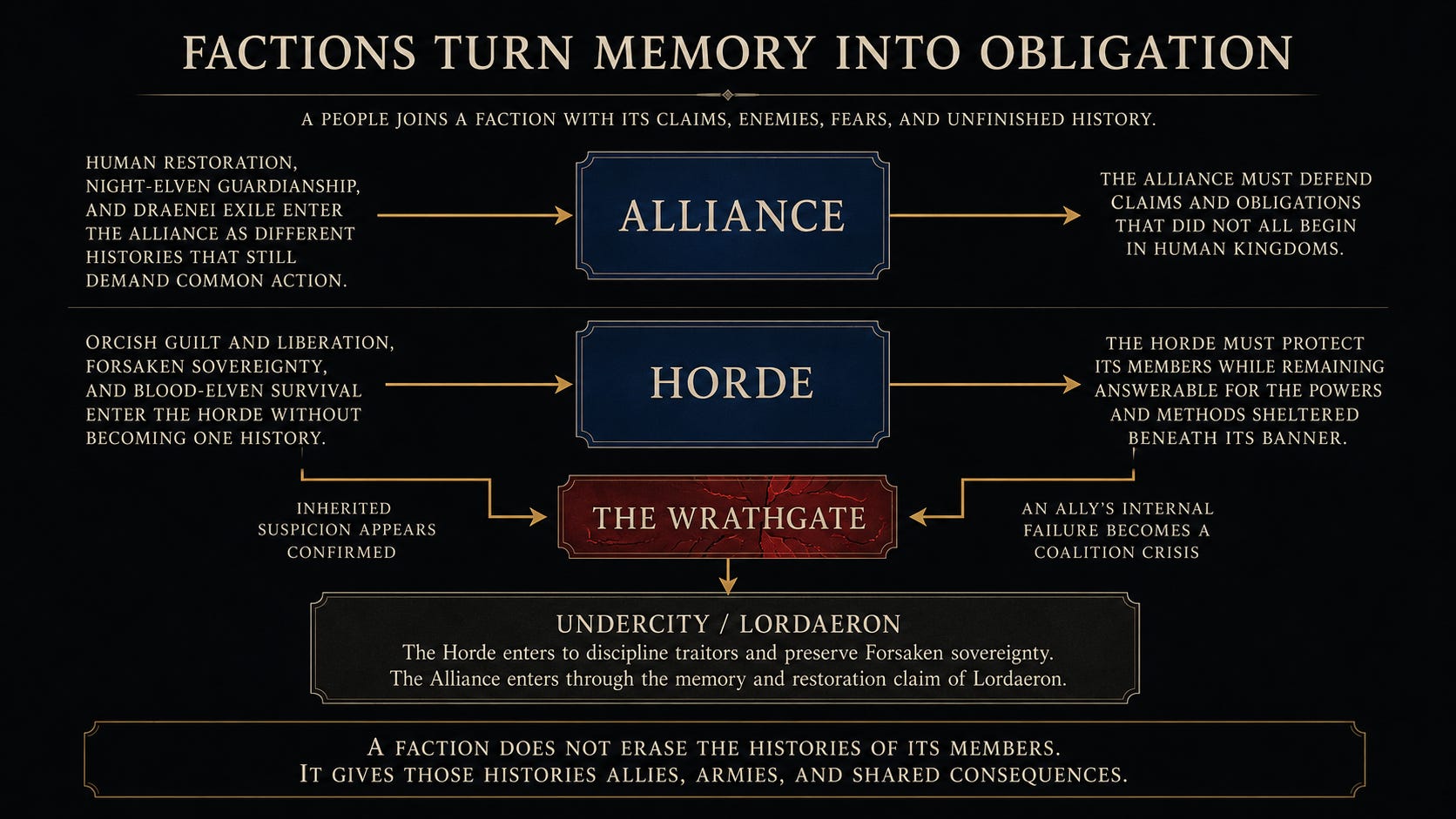
When the Forsaken join the Horde, a part of Lordaeron joins them.
So do the living survivors who still regard that kingdom as theirs, the fear produced by plague and necromancy, and the question of whether those who died beneath a kingdom can inherit it in a form the living no longer recognise. By offering the Forsaken political shelter, the Horde accepts the possibility that these disputes will eventually demand an orcish, tauren or troll response.
Factions change the scale of history by making several peoples answerable for one another’s unresolved claims.
Civilizations can argue internally over what should be preserved and who belongs. A coalition must act before those arguments are settled. It decides that an attack upon one member concerns the others, that one people’s territory may be defended by soldiers from another, and that methods developed inside a particular catastrophe will now be judged as the conduct of the banner sheltering them.
The Alliance and Horde emerge from different histories, but neither speaks with one memory. Each supplies a political language through which its members learn to recognise danger, loyalty and legitimate possession.
For the Alliance, that language is shaped by continuity. Kingdoms survive through recognised institutions and succession. Displaced peoples retain claims upon homes from which they have been driven. Lordaeron does not become politically empty merely because it can no longer govern itself. Its survivors remain, its orders continue elsewhere, and its ruins can still be imagined as territory awaiting restoration.
The Forsaken disturb that expectation because they cannot be placed cleanly outside the kingdom’s history. They are continuous enough to remember Lordaeron and transformed enough to appear as evidence of the force that destroyed it. Their claim to the land confronts the Alliance with a succession it has no form for recognising.
Horde membership places military protection around that claim. A conflict between human survivors and the Forsaken may therefore become a conflict with peoples who possess no direct inheritance in Lordaeron. Orcs may stand between the living heirs of a human kingdom and its undead former citizens. Tauren may be asked to defend allies whose methods trouble the sacred limits through which tauren strength is understood.
The arrangement follows the experience from which the Horde has been built. Its central peoples know survival without uncontested legitimacy. Orcs carry conquest, captivity and exile. The Darkspear have repeatedly survived displacement. The tauren entered under immediate threat. Membership can begin with aid offered when no older institution of protection remains. That openness allows the Horde to recognise a people whom the living kingdoms struggle to receive as political equals. Recognition also brings responsibility. If the Forsaken act beneath Horde protection, their methods cannot remain an entirely private matter. Shelter implicates the sheltering power.
The blood elves join through a different fracture. Older cultural affinities might have drawn them toward the Alliance, but resemblance cannot outweigh abandonment and immediate need. Quel’Thalas requires support in the world that exists after its destruction, not recognition of the world that existed before it. Their accession changes the Horde. The coalition now contains a surviving state whose hierarchy, magical culture and political memory differ sharply from those of its orcish centre. The blood elves retain a court, a territory, a sacred dependency and an account of betrayal that predates their membership.
Joining the Horde protects the remaining kingdom, but it does not make the Sunwell an orcish inheritance or the destruction of Quel’Thalas a memory shared equally by every member. Those histories remain blood-elven while becoming capable of directing Horde diplomacy and war. The Horde becomes responsible for a form of survival that does not resemble the histories through which orc, troll or tauren allegiance was first imagined.
Night elves and draenei place a related demand upon the Alliance. Night-elven claims arise from sacred guardianship and a history older than the human kingdoms. Draenei carry exile, faith and an enemy whose pursuit crosses worlds. Their membership forces a coalition organised partly through law, crown and surviving kingdom to recognise obligations that do not originate in human succession.
Every accession alters the political grammar of the faction receiving it. The Alliance must carry claims that human restoration cannot settle by itself. The Horde must provide more than an enlarged expression of orcish liberation. Membership becomes meaningful where the political centre accepts voices capable of contesting its own habits.
That judgment is especially visible within the Horde because Thrall gives the coalition such a powerful personal centre. His life joins captivity and liberation, human formation and orcish inheritance, command and shamanic restraint. He helps peoples with different histories imagine that their survival belongs together.
The same authority creates a vulnerability. If the Horde’s limits exist only because Thrall personally accepts them, the coalition has not made restraint durable. Cairne and Vol’jin matter because their allegiance does not erase the histories through which tauren and Darkspear obligations are understood. Their loyalty grants authority while preserving the right to decide that command has ceased serving the relation that made loyalty possible.
Alliance authority is distributed differently, but recognised institutions can preserve assumptions as easily as they preserve restraint. Historical succession may become a presumption of innocence. Former possession may be treated as permanent moral title. The coalition’s plurality cannot remove those tendencies, but it can prevent human political memory from becoming the only form of legitimacy available.
Neither faction is reducible to the virtue or shadow of its political grammar. Each remains an argument among the peoples it contains, and that argument becomes visible whenever common action demands a judgment their histories do not settle in the same way.
At Mount Hyjal, those differences briefly become secondary. Humans, orcs and night elves cooperate because the Burning Legion threatens the world in which any of their separate claims could continue. The alliance is real. The victory would not have been possible without it. The battle does not reinterpret the histories beneath the cooperation. The orcish invasion has still happened. Internment has still happened. Night elves still confront newcomers whose presence has altered lands they guarded long before the eastern kingdoms knew them. Common danger creates action faster than trust.
At the Wrathgate however, that distinction collapses into violence.
Alliance and Horde forces enter Northrend carrying different histories of the Scourge. For a time, those histories support a shared campaign. Then Putress releases the plague across the battlefield, killing soldiers from both factions while striking at the Lich King’s army. The conspiracy involving Putress and Varimathras turns the atrocity into an internal seizure of Undercity.
The betrayal arrives in a field already prepared to interpret it.
For the Horde, the event exposes the risk accepted when the Forsaken were granted shelter. Weapons and institutions developed under Sylvanas have produced actors capable of escaping coalition control. The other members must decide whether the atrocity belongs only to traitors, to the state that contained them, or to the political order that allowed such methods to develop beneath its protection.
If the Horde treats the Forsaken as collectively illegitimate the moment their institutions fracture, its promise of political existence proves conditional upon the suspicion from which accession was meant to protect them. If it refuses judgment in the name of solidarity, shelter becomes permission.
The Alliance sees an atrocity that confirms inherited fear. The Forsaken have declared independence from the Scourge while preserving some of its most horrifying capacities. Their place within the Horde has surrounded those capacities with military protection. Distinguishing Putress from the Forsaken, and the Forsaken from the Horde, becomes politically difficult because the event appears to reveal what suspicion had predicted.
The Battle for the Undercity draws those interpretations into the same ground. Horde forces enter to remove the conspirators and recover the capital of an allied people. Their action joins internal discipline to the defence of Forsaken sovereignty.
Alliance forces enter through the memory of Lordaeron. Plague and experimentation make restoration appear not merely historical but morally urgent. What the Horde understands as reclaiming an ally’s capital can be understood by the Alliance as ending an intolerable occupation of a fallen human kingdom. The leaders do not invent these interpretations. The factions have already taught each side which history the place belongs to, whose fear deserves priority and what loyalty now requires.
This is the power of faction. It allows peoples to survive dangers they could not withstand alone, but it also teaches them to carry histories they did not create. A wound can call armies across continents, turn suspicion into policy and make one member’s internal crisis the concern of an entire world.
The Wrathgate does not create the hostility it releases. It gives inherited fear a new event around which to harden. One coalition’s suspicion appears prophetic; the other’s obligation to protect and discipline its member becomes unavoidable. Once memory has become political duty, its unresolved relation can return through actors who never experienced the original wound.
VI. When History Has to Choose
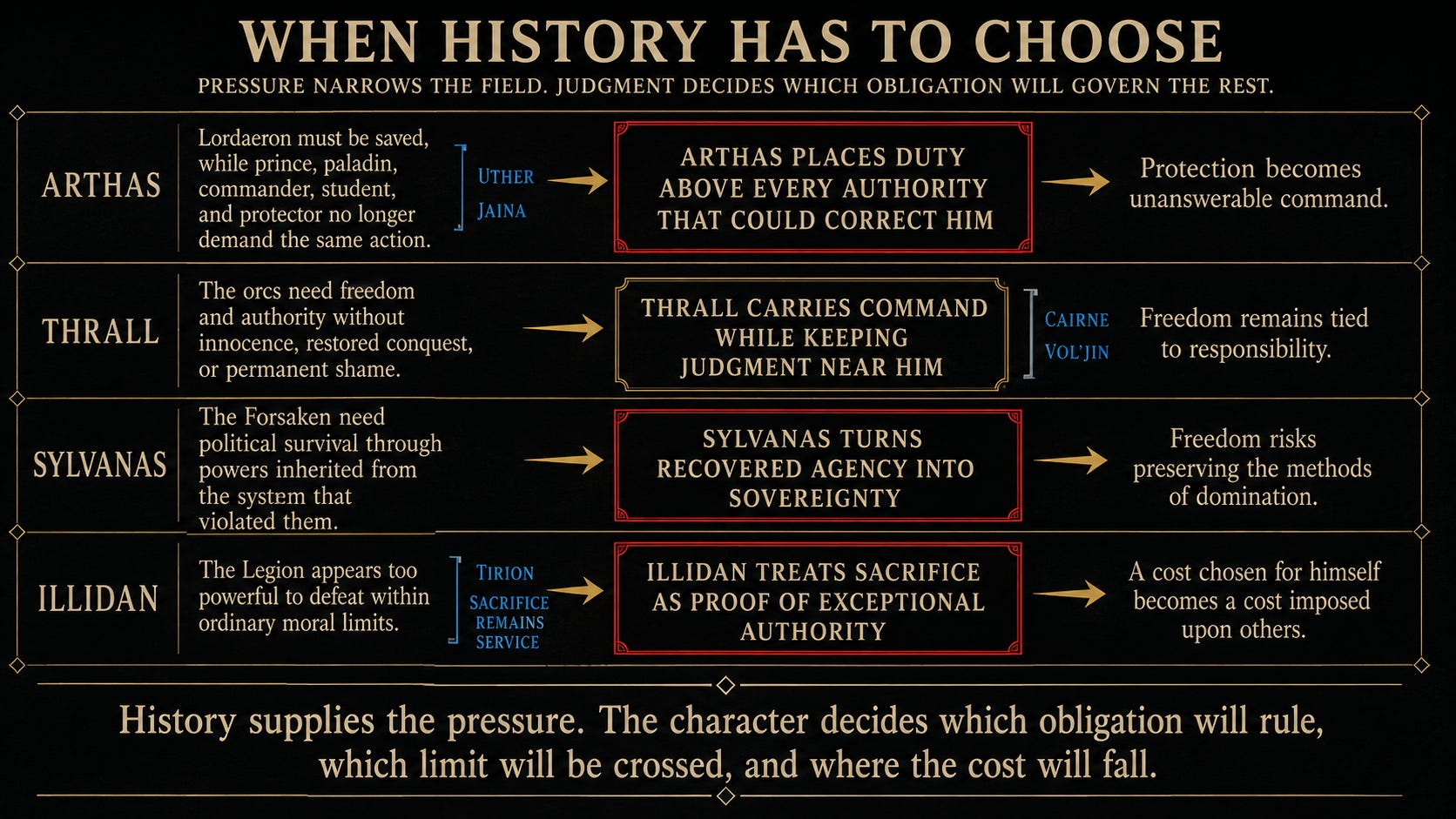
More than a teacher is being cast aside when Arthas dismisses Uther at Stratholme.
The city has consumed the infected grain. Its inhabitants remain alive, but Arthas believes delay will turn them into soldiers of the Scourge. As prince, he is responsible for the kingdom they may soon destroy. As paladin, he is bound to protect the innocent standing before him. As commander, he must decide before certainty is possible. As Uther’s student, he acts beneath an authority whose judgment he has not formally outgrown.
These roles had once appeared to express the same duty. The plague divides them against one another. Protecting the kingdom now seems to require killing a city within it. Obedience to Uther preserves the discipline of the order while accepting a danger Arthas considers intolerable. Waiting for proof may protect the innocent from an unjust sentence, but only by risking the transformation that would make rescue impossible.
Uther refuses a command that would destroy the moral authority through which Arthas expects obedience. The prince answers by dissolving their relation: if the institution will not serve the necessity he sees, he will act without it. Jaina’s departure removes another bond. She does not deny the horror of the situation, but she will not let attachment convert his judgment into her own.
Their refusals prove that the emergency does not contain its own verdict. All three stand before the same city. What separates them is the obligation each refuses to sacrifice.
Arthas preserves the duty to save Lordaeron by cutting it away from the relationships that once defined what saving Lordaeron meant. Protection no longer remains answerable to teacher, companion or sacred order. The kingdom becomes an end whose survival can justify acts no other authority may restrain.
Everything that follows enters an altered field. Retreat no longer appears prudent; it abandons the dead and allows Mal’Ganis to escape. Soldiers who wish to return home become obstacles to the mission they were commanded to complete. Frostmourne’s warning can be accepted because the cost seems to belong to Arthas while the victory it promises belongs to everyone.
The sword does not teach him that necessity outranks restraint. It finds him after he has begun organising authority around that belief.
The plague, the city and the sword are particular, but the permission they reveal is more durable: when the danger is great enough, the person who recognises it most clearly may claim freedom from every judgment that could delay him. The remedy begins carrying the wound it was meant to end. Arthas opposes domination by granting himself unanswerable command. He fights an enemy that turns people into instruments while treating soldiers, citizens and companions according to their usefulness to the mission. He seeks to save a kingdom by dissolving the relations through which the kingdom had given his authority meaning.
His decision changes more than his personal fate because several structures meet inside his position. The fracture passes through his relationship with Uther and Jaina, the legitimacy of princely command, the future of Lordaeron and the meaning of the power he is willing to accept. The choice becomes historical because those layers change direction together.
Thrall inherits the question Arthas leaves behind: whether authority can meet catastrophe without freeing itself from judgment.
Orcish command has already served conquest, manipulation and the destruction of other peoples. Warchief is an office burdened by what Warchiefs have commanded, while orcish strength remains entangled with the force that weaponised it.
Thrall cannot recover identity through strength alone, as though captivity were the only wrong in orcish history. Nor can guilt become permanent definition, leaving the people free from their camps but unable to claim a future beyond the judgment of those they invaded. His authority must hold responsibility and liberation together without allowing either to cancel the other.
Warchief and shaman bring that tension inside one person. The Warchief must act quickly enough to liberate a people, establish a homeland and hold a coalition together. The shaman listens within a relation whose answer cannot be compelled. One office concentrates action; the other denies that desire can certify itself.
Cairne and Vol’jin extend that judgment beyond Thrall’s conscience. Their loyalty gives the Warchief real authority without erasing the histories through which tauren and Darkspear obligations are understood. They preserve the possibility that allegiance may refuse command when command no longer serves the relation that made allegiance legitimate.
Grom’s final act holds the same contradiction. Corrupted strength can turn against its source without erasing its earlier use. Thrall must therefore build a future in which freedom does not require innocence and responsibility does not become another form of captivity.
Durotar gives that answer ground. Exile might have become a permanent humiliation or a licence to seize whatever strength could prevent humiliation from returning. Thrall tries to make it the beginning of a people who remember both what was done to them and what was done through them.
Where Arthas removes those who contest his definition of duty, Thrall carries authority while keeping judgment near him. History determines what each must answer. It does not decide how the answer must be given.
One of Arthas’s answers reaches Sylvanas before she can choose the form in which it arrives. She defends Quel’Thalas and is transformed into an instrument of the force she opposed. When the Lich King’s command weakens, recovered agency does not restore her body, former life or place among the living. Freedom begins inside conditions created by the violator.
Her refusal is nevertheless real. Breaking from the Scourge, gathering other liberated undead and giving political form to their survival all oppose the reduction of conscious beings to tools. Her wound becomes one source of leadership because she understands the condition shared by those who follow her.
The difficulty begins when refusal must become government.
The Forsaken require protection in a world that doubts their legitimacy and fears the capacities still available to them. Their sovereignty cannot depend upon being recognised as harmless, yet the powers through which they defend themselves remain marked by the very system from which they escaped.
Vengeance can join personal violation to collective purpose for a time. Arthas supplies a single object toward which anger, survival and the need to prove independence can be directed. It cannot decide what freedom should become after the enemy is gone, or whether methods inherited from domination have been transformed merely because they are now used by those once dominated.
Every rejection from the living makes autonomy more urgent. Every act of coercion or plague performed in autonomy’s name appears to justify that rejection. Sylvanas stands inside the resulting circle, carrying a claim against Arthas, responsibility for a people denied ordinary restoration and authority over capacities formed through necromantic command.H er question is not whether suffering excuses cruelty. It is whether agency recovered inside the methods of domination can become answerable to anything beyond the refusal ever to be dominated again.
Illidan reaches the same boundary from another direction. Where Sylvanas awakens to find contamination already present within her possibilities, he chooses transformation as a weapon against enemies he believes ordinary restraint cannot defeat. That willingness has genuine moral force. Refusing every compromised means may leave effective power entirely in the hands of the enemy. Someone who accepts exile, bodily alteration and hatred on behalf of a larger struggle may carry costs others prefer not to see.
The danger begins when endurance functions as proof. Having crossed boundaries others preserve, Illidan interprets their refusal as evidence that they do not understand the scale of the danger. Because he has sacrificed more, he begins to assume that he can judge more. The price he chose becomes authority over prices no one else chose.
Arthas derives exception from duty: the kingdom must be saved, and opposition therefore becomes obstruction. Illidan derives it from sacrifice: he has borne what others would not, and their judgment therefore no longer reaches him. Both begin with dangers that cannot be dismissed. Their distortion lies in treating the truth of the threat as proof that only one person may determine the answer.
Tirion preserves sacrifice through another relation. Condemnation and exclusion do not convince him that conviction was false, but neither do they turn suffering into permission to place himself above service. The burden he accepts remains bound to the people and principles for which it was accepted.
His sacrifice deepens what he is answerable to. That distinction is small enough to disappear beneath spectacle and large enough to divide entire histories. A person may cross a boundary because the world requires a cost. The crossing does not automatically grant the right to decide what everyone else must lose.
Arthas, Thrall, Sylvanas and Illidan matter because incompatible histories meet inside positions from which action cannot be avoided. The counter-decisions around them matter for the same reason. Uther and Jaina show that Stratholme did not mechanically determine Arthas. Cairne and Vol’jin preserve judgment within allegiance. Grom turns corrupted strength against its source without rewriting its history. Tirion accepts cost without allowing cost to become jurisdiction.
Pressure may narrow the field, but it does not complete the choice.
A character becomes structurally powerful when no available action can preserve every legitimate demand carried by the position. The decision reveals which obligation will govern the others, whose refusal will retain authority and where the remaining burden will fall.
Once made, the decision transforms institutions, offices and political expectations. It changes what later people inherit and what later dangers appear to permit. A kingdom is ruined, a homeland founded, a people gathered, an exile fortified. The original chooser may die, depart or lose the authority through which the choice was made, but the relation does not disappear with them.
It remains in the things people carry, the places they build and the paths others are made to walk.
Next: Act III — The World Remembers
Act II has followed history as it becomes a people, a political obligation and finally a choice made beneath pressures no person created alone.
The final act enters what those choices leave behind. Warcraft preserves history in weapons, crowns, cities, ruins and the repeated actions through which players learn the world. These separate inheritances will begin gathering beneath the same white sky, until the road returns to Icecrown and the image with which this essay began.
Arthas will die. Frostmourne will break.
The crown will remain.