
Star Wars Isn’t Your Political Allegory
It’s myth, and adults forgot how to read it
Introduction
I grew up with a drawer.
A drawer full of VHS tapes. I didn’t know what myth was yet, but I knew Star Wars wasn’t just entertainment. It had that older kind of gravity. The kind you can’t explain, but want to return to.
That’s the version of Star Wars I met first.
And i’ve been trying to protect it ever since.
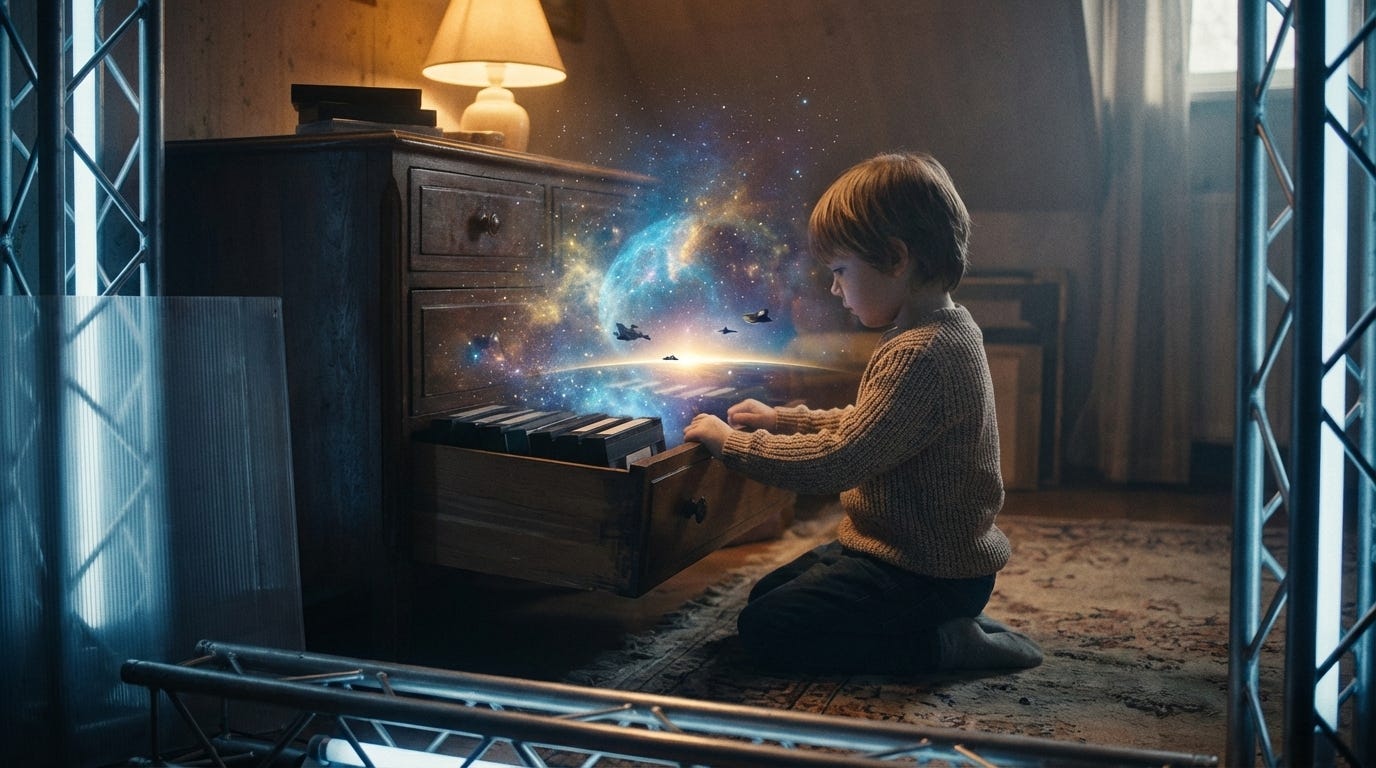
The drawer
I’m lucky in a very specific way: my father is a purely creative person. A guitar player through and through. The kind of man who lives in tone, rhythm, and mood.
My parents divorced when I was too young to really understand it. Four years old, maybe, so my relationship with my father wasn’t daily. It was visits. Ritual time.
A different house with a different atmosphere.
And he had VHS tapes.
A broad collection. The kind of library a child can only revere. I wasn’t old enough to choose what I wanted to watch with any coherent strategy. I didn’t have taste yet.
I had gravity. And my father—intentionally or not—pointed that gravity at Star Wars.
He placed me in front of it. That was that.
I watched and rewatched the original three almost religiously. There’s no better word for it. It wasn’t background noise. It was a return. A revisiting. Something you do because it stabilizes you. Something you do because it feels larger than you, but somehow also addressed to you.
The ritual became physical: going back to his place, opening the drawer where the VHS tapes were stored, pulling out A New Hope, and standing in front of him holding it up like an offering.
Press play. Let the room change.
And it always did.
Star Wars as a child’s native language
I’m genuinely happy that this is how I experienced Star Wars. I encountered it before reviews, before commentary, before the grown-up urge to translate everything into verdicts.
Just a boy and the magic of Star Wars and myth.
And when i say “myth”, i mean it in the oldest sense:
Story as deep architecture. A pattern that goes straight into the body.
I didn’t know words like archetype or symbolism, but I knew what it felt like when a story was doing more than entertaining me. I knew when a story was building a world inside me.
For me, Star Wars was like weather.
Weather isn’t something you agree with. You step into it. It conditions you. It changes what you expect from the day. It shapes you without asking permission. That’s what Star Wars did in my childhood. It trained my imagination.
It became the seed of everything I’d love later—science fiction, yes, but not the sterile kind. Science fiction carrying ancient fire. Spaceships with souls. Technology wrapped around the oldest human questions: fathers and sons, temptation and courage, loss and loyalty, the strange weight of choosing the good when the easy thing is right there.
And because I found it early, I didn’t experience it as a debate, but as a given—like the sea, like storms, like the sense that there are forces at work beyond your small life.
Isle of Wight: Episode I as festival
By the time Episode I rolled around, I was almost twelve. We were on our yearly vacation back home on the Isle of Wight, UK, and my memories of that time are unusually vivid. I can still feel them.
Merchandise was everywhere. Stickers to collect. McDonald’s toys. Star Wars branded everything. This wasn’t just a movie release. It felt like a season. A public fever.
And I was fully inside it.
We went to the cinema together as a family, and I remember children wearing self-made Star Wars costumes. I remember mock battles in front of the theater. Little kids swinging plastic sabers with the seriousness of knights. Parents trying to herd them while secretly smiling. The whole place felt like a festival—like everyone had agreed to live inside this one story for a day.
I got to experience Episode I in the way George Lucas seemed to intend:
As wonder first. I wasn’t sitting there with a panel of invisible critics in my head.
I didn’t have the vocabulary for “clunky” or “pacing” or “trade disputes” as a punchline. I wasn’t scanning the film for reasons to be disappointed.
I was an eleven-year-old kid with my eyes locked on the screen while a world opened up.
And it was pure wonder to me.
Not a single part of it sat wrong. The standard complaints simply weren’t in the room. We were all thoroughly entertained for those two hours, but the deeper truth is that we were in it—the way kids are in things. Whole-bodied and undivided.
Little did I know there was a Star Wars community out there ready to tear this movie apart.
The intrusion: when the adult world arrived
After Episode I, the universe didn’t shrink for me. It expanded.
The games came fast in the following years. Side stories. New planets. New characters. Star Wars stopped being three tapes in a drawer and became a place you could walk around in. It felt like discovering extra rooms behind the walls of a house you already loved.
Around the same time, I ran into something else.
Other people’s ownership.
It wasn’t just that some fans disliked Episode I or the prequels. It was the stance, the tone. Disappointment turning into identity, critique becoming a badge. I started hearing repeated lines, repeated jokes, repeated contempt. It sounded rehearsed, as if there was a correct way to belong.
That was the first time I realized Star Wars wasn’t one thing out in the world.
There was my Star Wars—ritual, atmosphere & myth.
And there was their Star Wars—property, inheritance & courtroom logic.
I didn’t have the language for this yet, but I recognized the energy: a possessive kind of fan who spoke as if they were the true heirs. As if love had to be proven through dissection. As if being moved was naïve and being unimpressed was intelligence.
Because I’d experienced Star Wars early—before all the discourse—I kept finding myself in a strange position:
I was defending Star Wars from arguments i never wanted to have.
What I mean by “politics”
When people argue about whether Star Wars “is political,” they usually mean: does it mirror our current headlines? Does it validate a tribe? Does it signal the right values in the right language?
That use of the word “politics” is already a symptom.
Politics, at its best, is mediation with reality. It’s wrestling with hard problems so people can live. It’s governing. It’s choosing tradeoffs under constraint. It’s action with consequences attached.
What we call politics now often lives one step before that. It lives in posture more than action. Performance. Optics. Endless pre-game. A theater that can imitate moral seriousness while avoiding the burden of doing anything real.
And when that theater runs for long enough, it starts to train people. They stop recognizing the performance as performance. They start treating the stage as the world.
So when those adults experience Star Wars, they look for alignment, allegory, and messaging first, because that’s the only political language they’ve been taught to trust.
The real claim: Star Wars sits upstream of politics
This is the point that matters to me:
Star Wars can contain politics. It has senates, empires, war, propaganda, collapse.
But Star Wars sits upstream of politics.
It deals with the machinery beneath politics: fear, desire, attachment, power, the way people get captured from the inside. It asks what kind of inner rupture creates a tyrant, and what kind of inner poverty makes tyranny attractive.
That’s why the Force matters. In real Star Wars, it isn’t a “magic system.” It’s atmosphere. A living field where inner state and outer consequence braid together. Your emotions are not private. They have gravity and they bend what you become.
That’s why Anakin matters too.
He isn’t a political allegory. He’s a human pressure vessel. Too sensitive. Too open. Too much love without grounding. A person who can feel everything, and therefore can be steered by anything. The tragedy isn’t a simple “wrong choice.” The tragedy is an inner imbalance becoming a systemic event. A fall that changes the whole shape of the world.
That’s myth. And myth doesn’t ask which policy is correct.
Myth asks what fear does to time.
Myth asks what power does to love.
Myth asks what happens when you try to possess the future.
So when Star Wars gets flattened into politics-as-theater—when it’s written as topical allegory, as a mirror held up to today’s stage-fights—it can still be sleek. It can be tense. It can even look expensive.
But it loses the sky.
It becomes a story about surfaces, performed by adults who forgot what stories are for. And that’s the real reason I’ve spent so long defending Star Wars.
I don’t need Star Wars to be “nonpolitical.”
I just need it to stay mythic.
How adults flatten myth
Modern adults aren’t stupid. They’re trained into a different way of seeing.
A child accepts the terms of a story like Star Wars. The Force feels real because it’s experienced like weather. The villain feels real because evil is treated as a spiritual problem, not a debate topic. A lightsaber feels real because it’s a boundary made visible.
Adults today often take in a story like that with a filter already installed.
They distrust what can’t be measured. They treat meaning like a personal preference. They assume every symbol is a disguise for propaganda, ideology, or marketing. They learn to keep a distance from sincerity. They learn that being moved is embarrassing.
So they reduce myth into parts they can audit.
Symbolic causality becomes logistics.
Archetypes become psychology case files.
Ritual becomes plot mechanics.
Wonder becomes “cringe.”
In myth, scenes matter because they are true in a deeper register.
Mustafar isn’t impressive because lava is cool.
Mustafar is the inside of a man catching fire externalized.
Prophecy isn’t there to decorate the plot.
Prophecy signals a system in drift, a reality that can’t keep absorbing imbalance without producing a compensating figure.
That’s the language Star Wars speaks when it’s alive.
If you don’t speak that language, you stare right at the same images and only see plausibility problems.
What happens when Star Wars gets written in the flattened mode
When myth drains out, the replacement can look like maturity.
You get grit, procedure, moral ambiguity, groundedness. You get political vocabulary that feels familiar: oppression, resistance, surveillance, messaging, control. You get a story that’s legible inside the modern theater.
Some of that can be well made and even genuinely compelling. But it often loses the Star Wars atmosphere I grew up inside.
The galaxy starts to behave like a contemporary drama wearing Star Wars clothing. The metaphysic thins. The sky disappears. The Force becomes optional. Archetype gravity fades. The story becomes about surfaces because the writers are working in surface-language.
Then Star Wars starts to feel…. plastic.
And it’s definitely not because it touches politics.
It’s because it forgot the deeper layer that makes politics meaningful at all.
A myth shows you what kind of hunger makes corruption irresistible.
A procedural shows you the paperwork around corruption.
Both can be interesting. But only one feels like Star Wars to me.
Return: what I’m actually defending
So when I say I spent years defending Star Wars, I don’t mean I spent years defending a brand. I was defending the part of me that still knew how to receive a myth.
I was defending that childhood room-tone: the drawer, the tape, the ritual of holding up A New Hope like a request for weather. “Can i watch?” A phrase that didn’t mean “let’s consume something.” It meant “turn this world back on.”
Myth re-orients you. It gives you a sky again. It reminds you that good and evil aren’t opinions. It reminds you that fear collapses time, that love can become possession, that power always offers shortcuts that cost your soul.
That’s the Star Wars I know.
And I still recognize it when it appears.
Star Wars was never my politics. It was my weather.
And my nostalgia isn’t for VHS. It’s for the kind of perception that could sit in a cinema at eleven years old—undivided, starry-eyed—and feel a myth move through the bones before the modern adult world comes crashing into it with its theater and its compulsive need to turn everything sacred into an argument.
As a lifelong Star Wars nerd, this is absolutely my experience.
Excellent 🔥
Star Wars is 100% upstream of politics. It does not ask questions about what system of government is best, it asks moral questions. Questions about the fundamental nature of reality and of man.