
Elden Ring and the Collapse of Sacred Architecture
On the Shattering, competing metaphysics, and why the game refuses to comfort you.
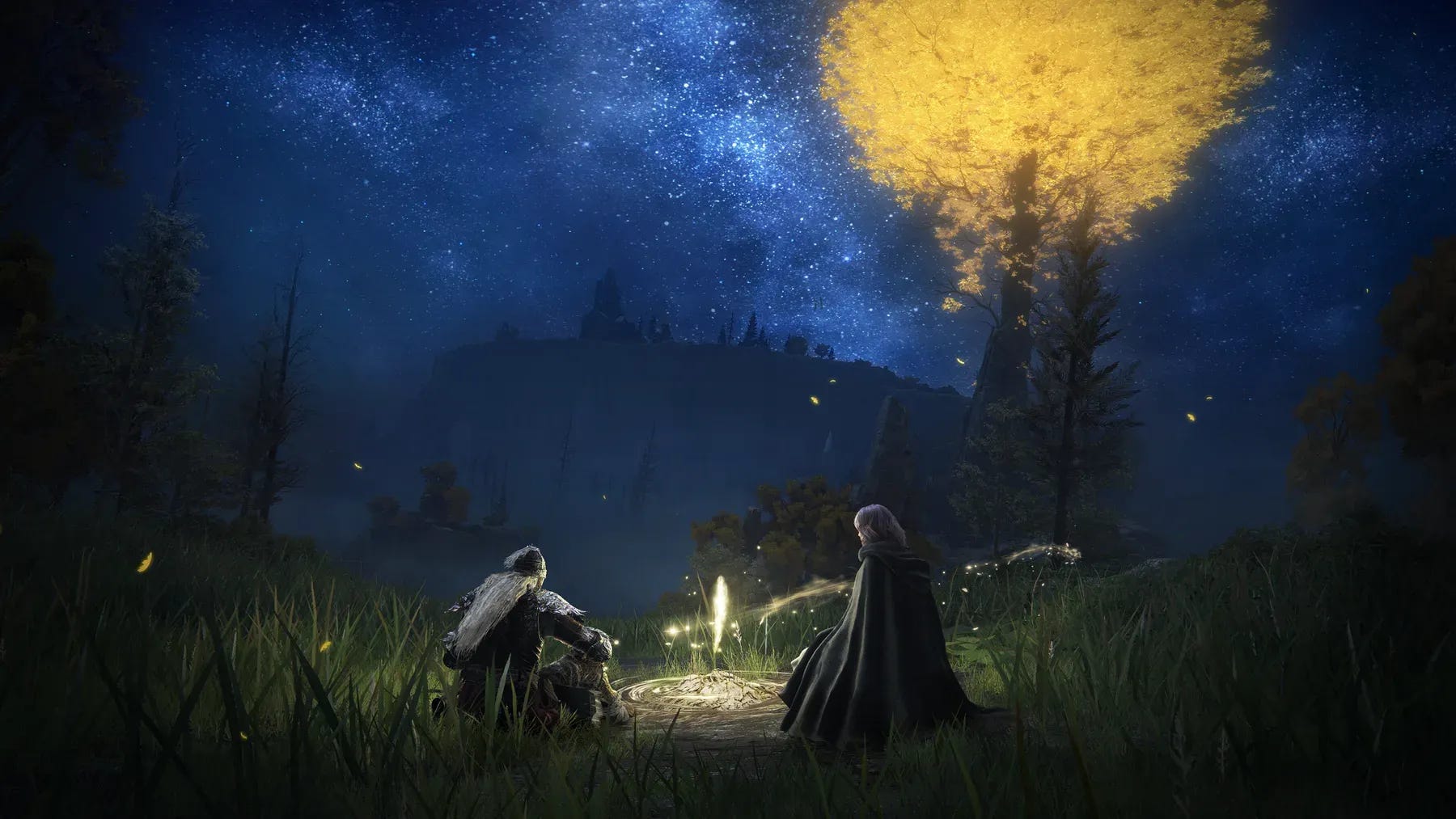
Video Games have been a part of my life for as long as I can remember.
I remember my mother bringing home a Sega Mega Drive for the first time when i was around 7 years old. My uncle was an avid Super Nintendo Player at the time and later owned the first Playstation in the Family. Consoles were this strange new household magic that would appear at Christmas, or at a friend’s place, or suddenly on the living room floor like a portal to dive into. Those are some of my fondest memories—half nostalgia, half reverence.
And either by accident or temperament, I never got locked into a single genre.
I grew up with Zelda and Mario, but I played racing games until my thumbs hurt.
I lost years to Simulators & MMO’s. I played strategy, roleplaying games, action & shooter games. Different worlds, different rules, different palettes.
At first, sure—games were escape, like they are for most kids. But somewhere along the line it turned into something else. Not escape so much as… immersion. Investigation.
My first apprenticeship was in electronics, and in hindsight that explains a lot. Because I took apart my consoles with the same energy I took apart game worlds.
If something fascinated me, I couldn’t just play it—I had to understand the shape of it.
I wanted to know what made the thing tick. I wanted to feel the rules from the inside.
There’s a certain point you reach with a great fictional world where it almost starts living in your head like a place you’ve been. As if you had completely absorbed its logic. Hyrule. Mass Effect’s galaxy. A dozen other places I could still “walk” in mentally if you asked me to.
Gameplay was always part of it. But the deeper hook, for me, was the world itself.
Its metaphysics, its constraints, the way it teaches you what matters without ever saying it outright.
Which is why it’s kind of ironic that I arrived almost four years late to Elden Ring, and much later to the Souls games in general.
A Souls game is a punishing action RPG where progress is earned through failure.
You get little guidance, fight tough enemies, die often, learn patterns, and return sharper.
I’m not what you’d call a typical Souls person. I’m the kind of player who should have bounced off it and stayed bounced. It took friends—people who play these games religously—nudging me back in whenever I hit that familiar wall of “I don’t get it.”
And even when it started to click, it wasn’t because I suddenly began to enjoy suffering for sport. What pulled me back was the same thing that pulled me into worlds as a kid: that stubborn feeling that the ruins weren’t random. That there was a coherent order underneath the confusion—even if the game refused to hand it to me.
At first I assumed the opacity was just… opacity. Difficulty-as-style. Lore-as-evasion.
It took a while before i realized something sharper:
Elden Ring isn’t withholding meaning because it’s trying to be coy.
It’s withholding meaning because you’re exploring a world where the thing that once unified meaning has already shattered, and everyone is living in the afterimage.
That’s the frame for this essay. And if it sounds abstract, don’t worry. We’ll start with the most common first impression:
This world is just deliberately confusing…
and then we’ll turn that impression inside out.
The false first impression: “this world is just withholding”
Most fiction teaches you how to read it.
You enter a new world. The world reveals its rules. The rules produce conflict. The conflict slowly discloses meaning. It’s a forward motion in general. Even when a story is complex, there’s usually an implied contract: stay with me and I’ll make it make sense.
Elden Ring breaks that contract almost immediately.
You meet characters who speak as if you’re already supposed to know what they mean. You find items that offer lore in fragments—half-statements, names with no context, references to events you never witnessed. You move through spaces that feel ceremonial without ever being told what specific ceremony they served.
Everything, from the ruins to the characters that inhabit them, seems broken.
And so you do the obvious thing, you treat the confusion as a puzzle. You assume there is a missing explanation behind the curtain. You assume that if you keep going, the curtain will lift and you’ll finally see the “real story.”
“Is there seriously nothing in this world that’s going to help me make sense of it?”
That’s the early game mood. A kind of frustrated reverence. Like being in a cathedral where all the plaques have been scraped clean.
But here’s the switch—and it’s subtle enough that a lot of players never fully feel it:
Eventually, you realize you’re not dealing with a story that is withholding its structure. You’re dealing with a world whose structure has already been broken.
You’re not trying to discover how the world works.
You’re trying to understand what it used to work around.
That’s why the confusion has a strange taste to it. It’s not the confusion of “I’m too dumb to follow the plot.” It’s the confusion of entering an aftermath.
Like walking through Western Europe after Rome collapsed.
Every region insists it’s the rightful heir. The old order survives as ruins, habits, and competing claims.
That’s the actual vibe Elden Ring is built to generate.
Once you see that, the game stops feeling like an obscure lore puzzle and starts feeling like something else entirely:
A post-catastrophe metaphysics simulator.
The real structure: FromSoftware builds a symbolic system — then shatters it
Here’s the distinction that made the whole thing click for me.
In most fictional worlds, “lore” is ornamentation. It’s background. Flavor. Optional depth.
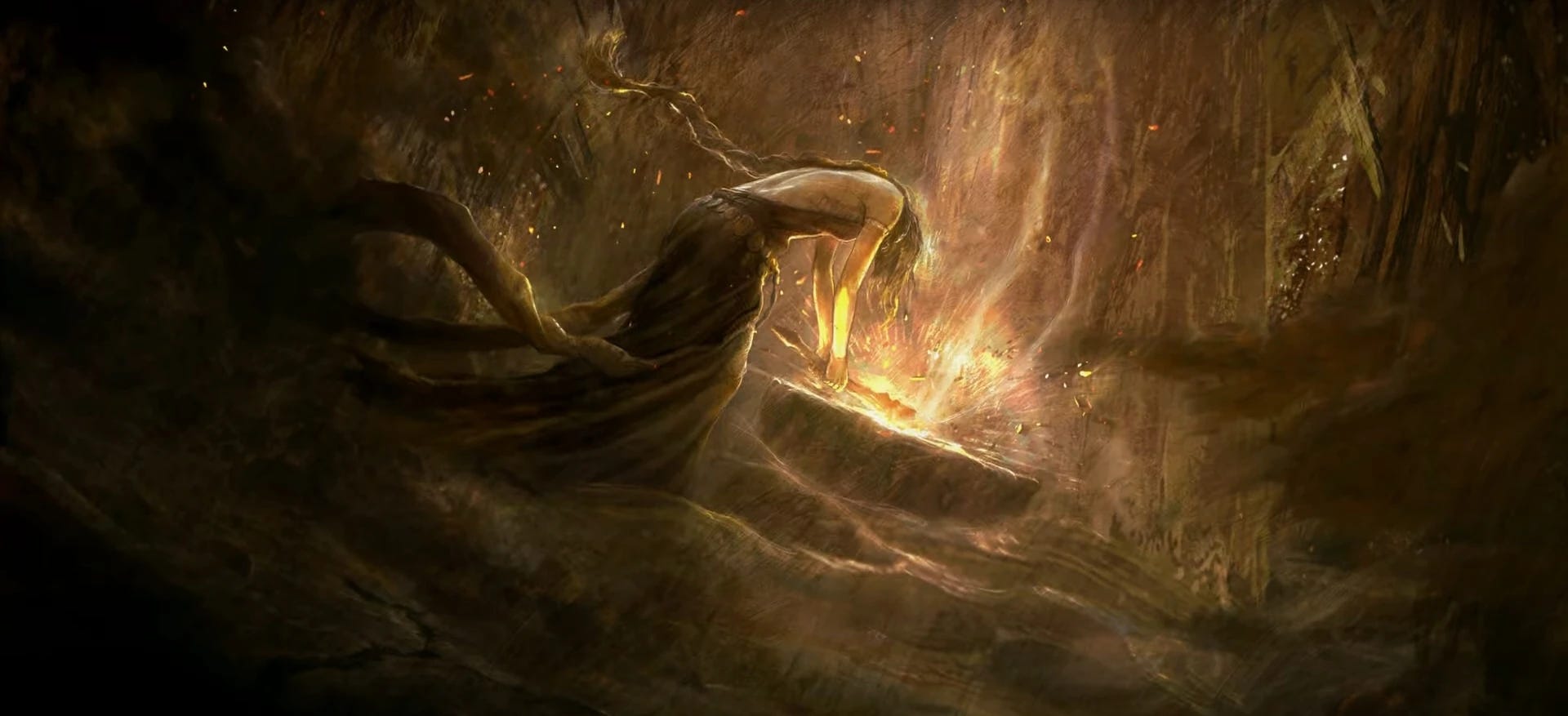
FromSoftware does something different. They build what I’d call a working symbolic system—a world where places, factions, characters, even curses, are not just plot elements, but carriers of belief and metaphysical assumptions—and then they shatter it on purpose.
That phrase, “working symbolic system,” matters, because it implies there was once coherence. There was once an architecture. There was once a center of gravity around which the world organized itself.
And you are arriving after that center has collapsed. Which means you’re not piecing together what the world is about so much as circling what it was about.
The ruins don’t feel like set dressing. They feel like doctrinal debris.
You can sense that the world used to have a “why.” A higher arrangement. A hierarchy of meaning. Something that told people what was sacred, what was forbidden, what counted as “good,” and what counted as “corruption.”
But the game refuses to give you that “why” in a clean form because—and this is the key—the world itself no longer has access to it in clean form. The Lands Between are full of people and creatures still living by rituals and instincts built for a cosmos that doesn’t exist anymore.
At first, you interpret the silence as developer coyness. Later, you start to interpret it as catastrophe. And that is a very different experience.
It stops being: where is the explanation?
And becomes: what kind of collapse could make an entire world continue moving like this?
Here, the game starts to feel less like fantasy and more like anthropology.
The anthropology of a civilization after its metaphysical center broke—while the habits, institutions, and rival truth-claims kept walking around in its skin.
Sounds eerily similar.
You begin to see why Elden Ring doesn’t offer to comfort you the way most stories do.
It doesn’t reassure you that if you try hard enough the world can be restored.
It doesn’t even reassure you that there is a clean restoration to aim at.
It offers the walk, and it offers weight.
It offers the strange experience of moving through a world that still behaves as if meaning is real, even though nothing in it can fully verify that meaning anymore. And once you notice that, the “opacity” begins to look less like a gimmick.
It begins to look like the most honest possible way to depict a shattered sacred order.
The collapse of “religious architecture”
Let me name the thing I’m circling with a slightly dangerous phrase:
religious architecture.
I don’t mean “religion” in the modern, narrow sense—churches, creeds, arguments about doctrine. I mean it in the older, structural sense: the scaffolding that tells a civilization what is real, what is higher, what is worthy, what is forbidden, and what kind of life counts as aligned.
Every serious culture has some version of this, even if it insists it doesn’t. It’s the invisible geometry beneath everything else.
And in Elden Ring, that geometry has collapsed.
You can feel it in the landscape itself. The Lands Between are not merely ruined; they are post-sacred. The world still contains temples, thrones, cathedrals, rituals, ranks, relics—yet none of these things feel securely rooted in a shared order. They feel like forms that survived the death of their center.
That’s why so many locations feel ceremonial without explanation. The game isn’t teasing you. You are arriving after the explanatory layer has been shattered.
No one in this world still remembers the whole.
In a functioning symbolic system, the sacred provides cohesion. It binds disparate institutions into something like a shared reality. When that sacred center collapses, the institutions don’t instantly vanish. They keep moving, like muscle memory.
But the “why” behind them is gone, or splintered into competing fragments.
The Shattering refers to the breaking of the Elden Ring, the sacred framework that structured reality itself. Its fragments were seized by competing demigods, fracturing the world into rival visions of what order should be.
The Shattering in Elden Ring is not simply a civil war, but metaphysical fragmentation. The world is full of people still trying to live inside an order that no longer holds, and that’s why Elden Ring’s “meaning” is not given to you.
It can’t be, because meaning in this world is no longer a single stable thing. It has become contested terrain.
You’re not stepping into a cosmos, you’re stepping into a dispute about what the cosmos is.
Which brings us to the thing that makes the NPCs feel so uncanny—why everyone seems to talk past everyone else, why their quests feel like half-remembered prayers, why so many conversations feel like you’re eavesdropping on a cult you don’t belong to.
It’s because you are.
Why the NPCs feel like strangers: competing metaphysics in the same landscape
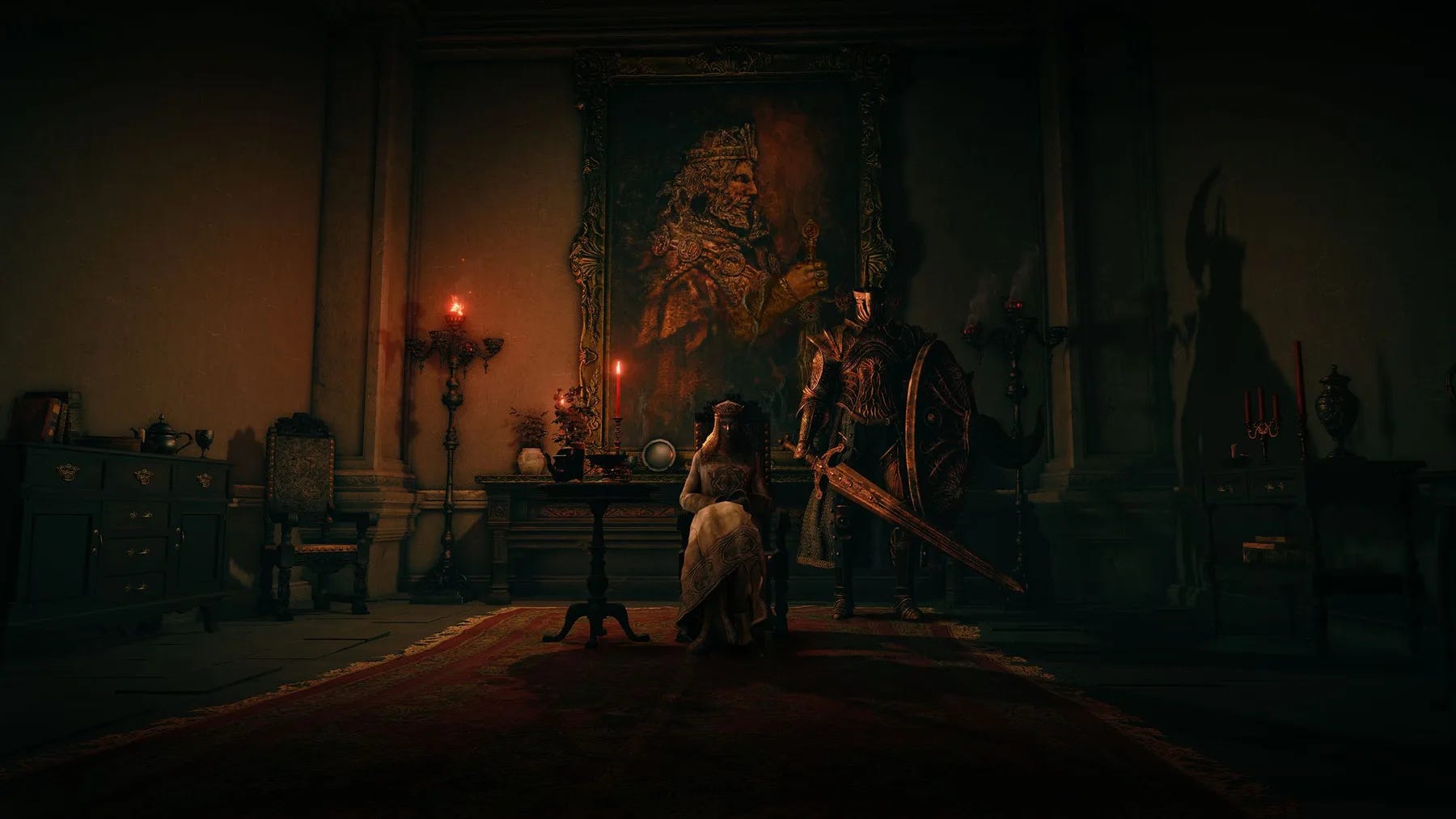
Where most games give you factions, Elden Ring gives you metaphysics wearing faction clothing.
You meet characters who aren’t merely aligned with a political side; they’re aligned with an interpretation of reality. And what makes them feel so strange is that they don’t share a common vocabulary. They aren’t disagreeing within one worldview. They’re living inside different worldviews, side-by-side, on the same soil.
That’s why it can feel like every NPC is talking from a different religion—because, functionally, they are.
One person is oriented around Order—around the idea that reality has a right arrangement, a proper hierarchy, a lawfulness that must be reasserted even if it costs lives.
Another is oriented around Rot—not merely as disease, but as an alternative sacred principle: decay as truth, corruption as transformation, the world returning to its deeper processes.
Another around Death—sometimes as inevitability, sometimes as theft, sometimes as something broken, sometimes as something that must be restored.
Then there’s Blood, Chaos, Escape—each one less like a “team” and more like a competing gravity well.
And the game’s genius is that these metaphysics aren’t just stated in dialogue. They’re baked into geography, enemies, aesthetics, and the kinds of choices each path invites. The belief systems have texture. They have architecture. They have ritual shapes.
You can stand in one place and feel multiple realities trying to claim the same world.
It also explains why the NPCs often seem… not exactly insane, but incompletely human in a specific way. Like they’re mid-incantation. Like they’re speaking from inside a vow. Their speech has that odd theological quality: half confession, half instruction, half riddle.
They’re not written to be psychologically “naturalistic.” They’re written like survivors of a broken sacred order, trying to keep their fragment alive.
Which makes the player’s position very unusual, because you aren’t simply choosing a side in a war. You’re moving through a landscape where the old unity is gone, and every surviving force is trying to become the new unity. And because the world has lost its shared center, each fragment has to behave like it could be the whole.
That’s what gives Elden Ring its peculiar spiritual atmosphere. The lore is hidden and truth is dispersed. The world is full of partial gods, partial doctrines, partial salvations—each one carrying enough weight to be compelling, none of them stable enough to be final.
NPC’s in this world don’t feel like quest-givers. They feel like emissaries of incompatible realities.
And you, the Tarnished, move among them like someone walking through the ruins of a once-shared religion—watching sects form in the rubble, watching rituals persist after meaning has fractured, watching competing absolutes bloom in the same broken soil.
Which sets up something deeper:
Elden Ring’s “story” is not primarily a plot you follow.
It’s a question you inhabit.
Elden Ring’s “story” isn’t plot — it’s a question
Once you see the world as a shattered symbolic system, the usual complaint—“there is no story”—starts to look like a category error.
There is a story. It’s just not delivered in the way modern audiences have been trained to expect.
Most narratives give you a sequence:
cause → conflict → revelation → resolution.
Elden Ring gives you something closer to a condition:
fracture → drift → competing claims → irreversible consequence.
The “plot” is not the main vehicle of meaning. The world is.
You don’t receive an explanation and then move through the world. You move through the world and slowly infer what kind of explanation could have once made it coherent. That reversal is why the game feels so alien at first.
And it’s also why the game feels strangely honest, once it clicks.
Because in a post-catastrophe landscape, you wouldn’t expect a clean narrative thread. You would expect fragments, ruins, factions, people speaking in half-prayers, the persistent afterimage of older laws still shaping behavior. You’d expect life continuing inside a broken metaphysics.
So Elden Ring’s “story” is less “what happens next?” and more:
What do you do when the thing that used to unify meaning has already shattered, but its fragments still govern everything?
That’s the question you inhabit every time you ride into a new region. Every time you find a new altar or corpse or ruined court. Every time you meet someone offering you a “path” that is really a metaphysical claim: this is what is real; this is what should be restored; this is what counts as salvation.
It’s why the game doesn’t rush to comfort you with clarity. Clarity would be a lie.
The world itself is not clear. The world is a battleground of partial realities, each trying to become the new center.
And if you play it like a puzzle—if your primary hunger is to “solve the lore”—you can end up frustrated, because you keep expecting the final reveal to arrive and tidy everything into one coherent doctrine.
But if you play it like a world-question, something shifts.
You start listening for patterns rather than answers.
You start paying attention to what the world repeats:
the persistence of ritual after belief has fractured
the way every “solution” offers order at a cost
the way each metaphysic asks for your loyalty in exchange for orientation
The game then becomes less like a story you consume and more like a space you’re being trained by.
Which leads to the design philosophy behind this entire method of storytelling.
Miyazaki’s childhood — and the hidden design philosophy of fragments
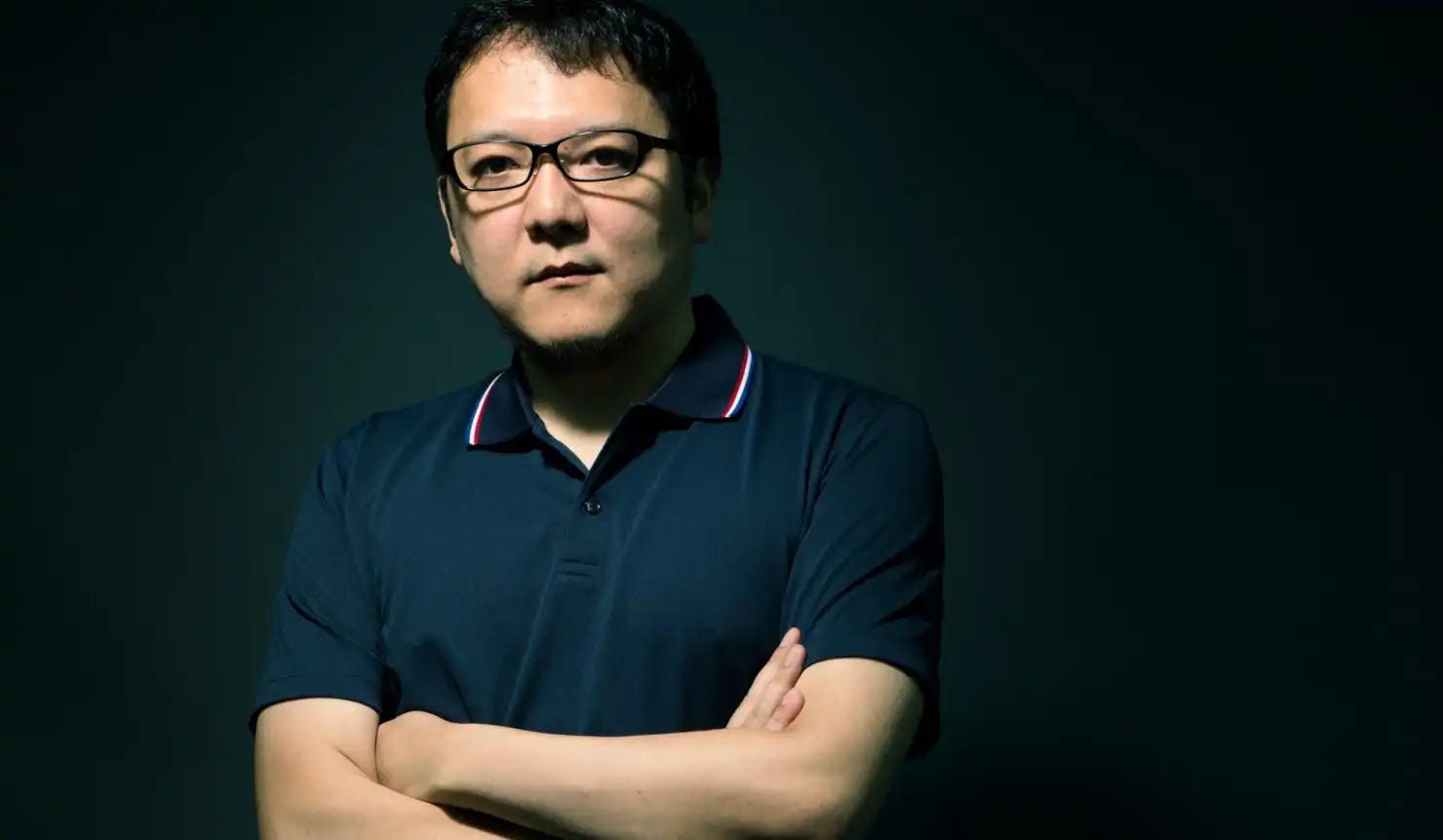
There’s a well-known detail about Hidetaka Miyazaki that suddenly makes a lot of FromSoftware’s storytelling feel inevitable.
As a child, he read fantasy books in English that he couldn’t fully understand. He would catch pieces—names, images, bits of dialogue—and then fill the gaps with his imagination. Meaning arrived to him as a collage: half received, half created.
That’s not a cute anecdote. It’s a design lineage.
Because Elden Ring doesn’t “tell you a story” so much as it recreates that childhood experience for you on purpose.
You catch fragments:
a phrase on an item description
a statue that implies a hierarchy
a boss whose aesthetics are a theological statement
an NPC speaking like they’re quoting scripture from a religion you never joined
And then you do what Miyazaki did as a kid:
You assemble. You infer. You imagine the missing connective tissue.
And the act of assembling is part of the intended experience. The player becomes a co-creator of meaning in a very disciplined way: you’re constrained by the fragments you’re given, and you’re rewarded for careful attention.
That’s why Elden Ring’s opacity is different from ordinary vagueness.
It isn’t “we’re mysterious because it’s cool.”
It’s: we’re giving you the experience of arriving after a catastrophe, holding only partial relics of what was once whole.
A fully explicit exposition dump would break that spell immediately. It would turn the game into a standard fantasy narrative with cool scenery.
The fragments are the point. Because the fragments force you to feel the collapse of coherence rather than merely understand it intellectually. They force you into the posture the world demands: humility, curiosity, patience, and a willingness to move without certainty.
In that sense, the storytelling style isn’t just aesthetic, but metaphysical.
It’s the only style that fits a world whose sacred architecture has broken, whose truths have splintered, and whose inhabitants are still trying—desperately—to live as if something whole remains.
And that is why Elden Ring doesn’t comfort you. It doesn’t even try to.
It asks you to walk through the ruins and learn to see what kind of world produces ruins like these.
This world doesn’t comfort you, and that’s rare
Most modern stories—especially modern fantasy—are built to soothe a particular anxiety. They may show suffering, betrayal, collapse, even horror… but they usually preserve a hidden promise: that beneath the chaos there is a recoverable order, and if you push hard enough, the world will snap back into shape.
The hero wins. The villain is named. The evil is localized. The wound is stitched.
The credits roll with the implication that meaning has returned.
Elden Ring refuses that kind of comfort, because the world it’s depicting is already past the point where comfort would be honest. The catastrophe has already happened. The metaphysical center is already shattered. There is no clean return to “before,” because “before” was the thing that broke.
And that gives the game its peculiar emotional pressure.
You can do extraordinary things. You can become powerful. You can defeat gods. You can restructure the world in certain directions.
But the game never quite lets you feel like you’ve solved it. It never gives you the sensation of the cosmos being fully healed and resumed.
It gives you something more unsettling: the sense that every form of restoration is also a form of imposition. Every ending is a metaphysical claim. Every “solution” is a trade.
Elden Ring doesn’t reassure you with a single clear moral axis. It doesn’t split the world into “the correct good” and “the obvious evil.” It populates the landscape with rival truths that are compelling for different reasons, each one expensive in a different way.
So when players complain that the game is “depressing,” I think they’re half right—but not for the reasons they think.
The game is not depressing because it’s hopeless. It’s depressing because it refuses to lie to you about what happens after a sacred order breaks. After a collapse, life doesn’t become clean.
It becomes plural. It becomes sectarian. It becomes improvisational. It becomes a competition of narratives, each claiming to be the new spine of reality.
And when you walk through that kind of world long enough, you start to feel the exhaustion of it: the constant need for orientation, the constant suspicion that every offered “path” is someone else’s metaphysical agenda.
That’s not “dark fantasy.” That’s the post-catastrophe condition.
Which is why Elden Ring feels so strangely… contemporary, even as it looks like myth.
How the game trains attention
Elden Ring rewards a certain kind of mind. And it’s not the mind that wants to be right quickly. It’s the mind that can remain present without full explanation.
The game trains you—quietly, almost without you noticing—in a posture that most modern systems do not train at all: attention without closure.
Think about what you actually do, moment to moment:
You move forward without certainty.
You gather partial information.
You test a hypothesis with your body.
You retreat.
You return with a revised interpretation.
You don’t “figure the world out” and then navigate it.
You navigate it in order to slowly earn a more accurate sense of what’s going on.
And this applies as much to the lore as it does to combat.
You learn to make decisions with incomplete knowledge. You learn to accept that some things won’t resolve neatly. You learn that “understanding” doesn’t always arrive as a clear statement—it arrives as a felt coherence between scattered fragments.
It’s almost the opposite of how most contemporary life tries to run your mind.
So much of modern culture is optimized to provide instant orientation: instant explanation, instant outrage, instant moral sorting. It tries to eliminate ambiguity before you’ve had time to look.
Elden Ring does the opposite. It forces you to slow down. To interpret. To carry uncertainty long enough for pattern to emerge. And once you’ve played enough of it, you start to recognize this as a kind of mental training.
You become less hungry for definitive statements.
You become more attuned to structure.
You stop demanding that the world “make sense” in a tidy way, and instead you start asking a more adult question:
What kind of world is this, such that these fragments are what remain?
It’s a different relationship to meaning.
Meaning as something approached—through attention, patience, and the willingness to move through the ruins without insisting that the ruins apologize for being ruins.
The posture it trains—patient attention under conditions of irreducible uncertainty—is rare, and once you’ve felt it, a lot of other storytelling starts to feel strangely… thin.
Closing — why it stays with you after the controller is down
I’m nowhere near “done” with Elden Ring.
I haven’t seen every ending, chased every thread, decoded every name. And strangely, that doesn’t bother me. In another kind of game it would. In another kind of story, not reaching the final clarity would feel like failure.
But Elden Ring doesn’t really reward completion in that way. It rewards contact.
It rewards the slow, almost devotional act of moving through a world that won’t simplify itself for you—learning its textures, noticing its repeats, feeling where the pressure sits.
The game hands you a perticular kind of silence. A silence you feel after walking through ruins long enough that you stop demanding they explain themselves. You start looking instead at what kind of life could have built them, what kind of collapse could have cracked them, and why the fragments still hold weight.
And maybe that’s the real gift of it: the game doesn’t ask you to become a hero who restores order.
It asks you to become a person who can stand inside disorder without needing to lie about it.
To keep moving without certainty. To live without closure.
To let meaning emerge slowly, the way it does in real life—through attention, through time, through the patience to hold what you don’t yet understand.
So when people say Elden Ring is confusing, I don’t disagree. I just think the confusion is part of the point. It isn’t the confusion of a story that forgot to be clear. It’s the confusion of arriving after the sacred architecture has broken, and realizing you’re not here to receive a neat explanation.
You’re here to walk the aftermath.
And if you’re willing to do that—if you don’t demand the world become small enough to fit in a summary—then a strange thing happens:
The game stops feeling opaque and it starts feeling true.
And that, I think, is why it lingers long after you’ve put it down.